

A Look at Recessions and their Impact on Librarianship

Image courtesy of Flickr user RayBanBro66
By Hilary Davis
Given the constant flood of reports comparing our current economic recession with past major recession events including the Great Depression, I want to explore the historical patterns of employment rates and salaries for librarians at times of recession and the role of libraries during recession events.
In 1933, Carl Milam, secretary of the American Library Association, along with Ora Wildermuth, an attorney in Indiana, and H.L. Woolhiser, a city manager in Illinois, held a radio broadcast called “How to Reduce the Library Budget.” The transcript (available from the National Municipal Review, 1933, vol. 22, no. 8) unpacks a revealing conversation about the pressures on libraries during the Great Depression and the corresponding aims of the American Library Association.
“Judge Wildermuth: Wages are down, and the incomes from every business and every property has been drastically reduced. In many cases the income from property is not sufficient to pay taxes, much less living expenses of the owner…In a time of depression we have to stop considering what is good for a well organized social structure and consider what is necessary for continued existence of the people. In my town we have been spending $90,000 per month for poor relief and that is not enough. Our public library spends about the same amount each year. Suppose we are reduced to the necessity of eliminating one of these functions, which will it be Mr. Milam?”
It’s 2009 and our nation is in a major financial crisis with a new leadership positioning itself to get our economy back on track. The media is spilling over with worsening updates on our economy, a shrinking job market and what it all means for citizens and their jobs. Paul Krugman, Nobel Prize winner for Economics in 2008, called the current economic downturn the “worst situation in two lifetimes” on the December 29, 2008 airing of CBS’ Face the Nation program:
By all accounts, the profession of librarianship is not immune to the compounding economic downfall. As of December 2008, the US National Bureau of Labor Statistics declared a 7.2% unemployment rate across all professions and industries (approximately 10,015,000 unemployed persons), representing the highest unemployment rate since 1991. Of that, librarians, trainers and educators make up 218,000 of the unemployed population. This is up from 98,000 unemployed people in this category in December 2007 to 218,000 in December 2008.
So, what does all of this look like for the librarianship profession, a profession that very recently (December 2008) was listed as one of the top professions by the U.S. News and World Report? How has librarianship fared over the past several economic recessions? How has our profession recovered from those recessions? What role are libraries playing during the current economic crisis?
Libraries during recession events
Praise for library services and collections during the current economic crisis is remarkably similar to the praise of libraries during the Great Depression. In his excellent investigation of the impact of the ALA on the anti-taxation groups that arose in response to economic collapse during the Great Depression, Brendan Luyt (2007) summarized a set of position statements from the ALA for the role of the library:
“as providing encouragement for the citizen to re-identify with state, in the form of loyalty to the public library, a state agency. The library was portrayed as mediating between the individual and the rest of society. Mediation had both ‘giving’ and ‘protecting’ functions. Through the library citizens could be given access to practical instruction, as well as to the ‘finer’ cultural things of life, while also being protected against the forces of anarchy and disorder.”
Fast-forward to today’s recession and it’s hard to miss the praise for the services and collections that libraries offer. These reports mirror similar marketing materials published by the Bulletin of the ALA during 1933 and 1934 promoting the value and role of libraries during the Great Depression. Take an eHow article for example, that promotes ways that citizens can make the most of libraries during an economic downturn:
“Members can re-skill themselves, enhance their knowledge, gain new capabilities and even save money while borrowing (instead of buying) popular books, study materials, novels and DVDs.” —eHow
Stories of libraries providing access to books, videos/dvds, cds, newspapers, magazines, journals, reference guidance and Internet service in addition to training and programming for children, teens and adults are popping up everywhere. A news-map snapshot of the latest news stories about the value of libraries over the past month on MetaCarta spotlights hundreds of locations where library usage has dramatically increased during the past year.
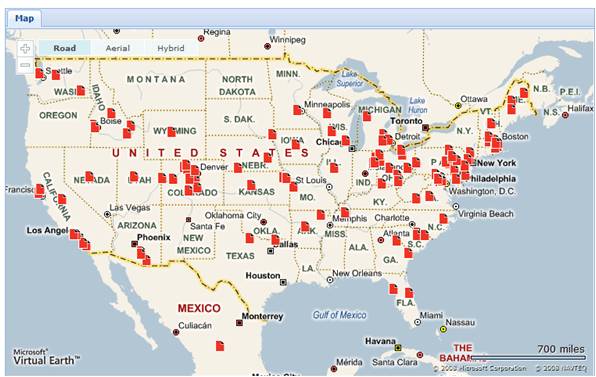
At the same time, these news reports are remarking on the incredulity of library shutdowns due to lack of budget funds.
Given the inherent value of libraries during the current economic crisis, Pennsylvania State Librarian Mary Clare Zales, testified before the House of Representatives that libraries are essential to the nation.
“The public library plays an even more important role as Americans are facing tough economic times. Library usage is up ten percent from the last economic downturn in 2001. Debbie Long of West Goshen in Chester County, Pennsylvania noted the price of borrowing one hardback book from the library saves her enough to fill her gas tank halfway. So this year, she is frequenting the West Chester Public Library instead of the bookstore. … Patrons are visiting their library for more than the borrowing of free books. Libraries offer databases with job listings, training on resume development, techniques for interviewing and 21st century skills needed to get that new job. The Washoe County Library System’s Community Resource Center in Nevada helped Stephanie D’Arcy, who hadn’t had full-time employment for several months, successfully get a job with the local parks and recreation department. … That library attendance has increased is not a surprise. Studies from generation to generation have shown that in times of economic downturn, libraries become busier.”
Furthermore, Library Journal (November 15, 2008) reported that the American Library Association (ALA) is seeking a $100 million stimulus package from Congress to “help libraries aid Americans as they deal with the nation’s current fiscal crisis.” With or without a funding stimulus, most libraries are undoubtedly facing significant budget cuts and seeking solutions via hiring freezes, layoffs, collections cuts, service cutbacks, foregoing computing refreshes, salary freezes, etc. Just a few examples:
- Free Library of Philadelphia system saved from closing 11 of 54 branches
- Nevada public library preserves children’s reading program, but stops filling positions and replacing old computers
- University of Tennessee Health Sciences Library announces collection funding unsustainable
- Cutback in library hours at Florida State University Libraries
Impact of recession events on librarian salaries and employment
While libraries are seeing huge increases in usage, the job market for librarians is being hit hard. With unemployment on the rise and hiring freezes and layoffs in effect, what might our profession expect and can we identify trends from past recession events to help inform our future? I am not an economist or a historian, but I am deeply concerned about the impact of the current recession on the librarianship profession and want to try to bring to light any evidence from past recession events to prepare librarians for what might lie ahead. Much of what is presented below lends itself to many different interpretations and I invite our readers to make up their own minds and share their own insights.
A recession is measured as a decrease in the Gross Domestic Product (GDP) over at least two quarters. This can also be conveyed as a percent change in the GDP, as displayed in the figures that follow. I used salaries and number of people employed as librarians as two indicators of how librarianship has fared during the past recession events. Giving credit to the sources of this data: average (a.k.a mean) annual librarian salaries came from the ALA Annual Salary Survey, a very handy report by Denise Davis from 2005 on librarian salaries and the Gerould Statistics 1907/08 – 1961/62. The number of people employed as librarians over the years came from the U.S. Census Bureau Statistical Abstracts and the U.S. Bureau of Labor Statistics.
The period of 1930-1961 included six recessions as identified by the U.S. National Bureau of Statistics. In Figure 1 below, these six recessions are represented by the yellow vertical bars. The GDP Percent Change is represented by the blue line and the Average Librarian Salaries is represented by the red line. From 1930-1939 (the Great Depression) the average librarian salaries slowly decreased from $2,099 in 1930 to a low of $1,591 in 1939. The following years from 1940-1947 show a gradual increase in the average salary from $1,724 in 1940 to $2,562 in 1947 even though there was a short recession from 1945-1946 (possibly due to the end of World War II). One could speculate that because the librarian profession was not sought after by males returning from service, that job security for the women holding those positions was solid. However, during the mild recession from 1948-1949, average salaries did drop 6.3% followed by a substantial rise of 15% in 1949 ($2,759). For the rest of this period, from 1950-1961, the average salaries continued to increase despite three more recessions. This data suggests that even during this turbulent period, for those librarians who did have jobs, their salaries bounced back and even rose despite some some mild recession events toward the end of the period.
Figure 2 describes the period from 1988-2007 which includes three recessions: 1990-1991 recession event tied to a decrease in industrial manufacturing and sales, 2001-2003 recession tied to the dot.com collapse combined with 9/11, and the current recession from 2007-present. Average librarian salaries increased steadily throughout this 20-year period, going from $29,675 in 1988 to $57,809 in 2007. The most dramatic increase in the average salary for librarians occurred between 1988 and 1989 when the average salary increased by nearly 12% (or $3,485). One might expect that the dot.com recession would have had an impact on librarian salaries given the profession’s close ties with the information industry, but does not appear to be the case. There could be many reasons why (e.g., librarianship, for the most part, was not at the bleeding edge of technology during 2001-2003), but the health of the job market has held steady with robust salaries during this period.
Taking into account the number of librarians employed, Figure 3 describes the period from 1977-2007 which includes four recessions: 1980-1982 recession tied to the Iranian Revolution and U.S. attempts to control inflation, 1990-1991, 2001-2003, and the current recession. The GDP Percent Change is represented by the blue line and the number of librarians employed is represented by the red line. A lack of data deemed that I could not include earlier time periods, including the 1973-1975 recession which was linked to the oil crisis of 1973 and the Vietnam War, but it appears that the economy is still in recovery mode from 1977-1978 as seen in the chart. What is evident is that during each of these recession events, the number of employed librarians decreased. The period from 1980-1982 saw a series of dramatic swings from a decrease in the number of employed librarians by 3.5% (dropped by 7,000 persons) in 1981 quickly followed by a sharp increase in 1982 by nearly 8% (an increase of 15,000 persons), immediately followed by another decrease of nearly 7% (dropped by 14,000 people no longer employed as librarians in 1983). The recession of 1990-1991 also saw a substantial decrease (nearly 7% or 15,000 people no longer employed as librarians). However, the period from 2001-2003 saw the greatest change – a drop of just over 16% (or 38,000 people not longer employed in librarianship). Stabilizing from 2004 to 2006, the number of people employed as librarians increased from 217,000 to 229,000. The latest data for 2007 report that the number of employed librarians again dropped to 215,000. This seems to indicate that the number of employed librarians is a much more volatile statistic and more susceptible to major economic downturns. If you are employed as a librarian now, count your lucky stars because your salary, if history is any indication, should hopefully remain fairly stable. If you’re in the job market now, you will certainly find it a rough road ahead as long as this recession lasts.
Figure 1: Comparison of GDP Percent Change and Average Librarian Salaries, 1930-1961
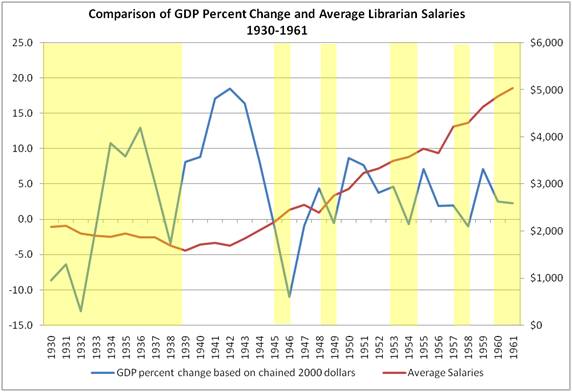
Figure 2: Comparison of GDP Percent Change and Average Librarian Salaries, 1988-2007

Figure 3: Comparison of GDP Percent Change and Number of Employed Librarians, 1977-2007

The Bottom Line?
Overall this is pretty rotten news. It’s possible that the U.S. Census hasn’t got the most current data and that much of this is certainly up for scrutiny; however, if the current recession is being called the worst recession since the 1930s, it’s hard to imagine the average librarian salary continuing to increase and the employment figures getting much better anytime soon. If you have a job, hold on it. If you don’t, there are some pretty good avenues to explore. In addition to hosting job ads, LISJobs.com is a great first stop for resources that help match librarians with free continuing education opportunities as well as help aligning your skills in a non-library workplace. The Special Libraries Association (SLA) has even set up a mentoring program for librarians who are between jobs or who have been laid off. Eventually, things will improve. We can see from past recession events, the profession does indeed rebound. And, because libraries are acknowledged as a fundamental force that holds societies together, I think the important thing to take away from this crude analysis and brief snapshot of libraries during today’s economic recession is that our profession is buoyant and has a good chance of weathering this storm.
The bright side of the recession is that libraries across the nation are getting the best PR in mainstream media that we’ve seen in a long time. Indeed, libraries have traditionally been strongly promoted during times of economic crises (e.g., American Libraries August 2002, pp. 62-63). The upsurge in use of libraries is good evidence as is the public outcry when a library is threatened with being closed down.
Revisiting the radio broadcast from 1933 on “How to Reduce the Library Budget,” Carl Milam, secretary of the American Library Association at the time, crafted a careful argument supporting the value of libraries during economic crisis. His arguments framed the necessity to uphold librarian salaries, look for efficiencies in government, and make cuts to libraries in the order of (1) decrease operating costs, (2) implement efficiencies in routine processes, and as a last recourse, (3) cut the collections budget. One of H.L. Woolhiser’s (the City Manager from Illinois) final statements from the broadcast is as true an argument for supporting libraries during today’s recession as it was for the plight of libraries during the Great Depression:
“The library exists to provide the means of self-education. Education is the interest of the state, and the educational institutions – school, libraries, universities – are engaged in the process of helping people to become intelligent members of society. In other words, society has a stake in what the library does. It is interested in having the library’s influence reach the largest number of people in the most effective way.”
Selected Resources for Further Investigation:
- ALA-APA’s Better Salaries/Pay Equity Bibliography
- Association of Research Libraries Annual Salary Surveys
- Tom Terrell and Vicki Gregory’s 2003 paper, “A Look at Now and Then: Salaries of Academic and Research Librarians”
- ALA 2002 report, “Public Library Use and Economic Hard Times: Analysis of Recent Data“
- Library Journal’s Placements & Salaries Surveys
- AL Direct January 7, 2009 issue includes 6 stories on libraries and the recession
Much appreciation to Emily Ford from ITLWTLP, Kim Duckett and Hyun-Duck Chung for providing thoughtful feedback on drafts of this post.
Pingback : “A Look at Recessions and their Impact on Librarianship”…01.14.09 « The Proverbial Lone Wolf Librarian’s Weblog
Hilary, this is certainly a timely post! Even after you wrote it ALA came out with their Advocating in a Tough Economy Toolkit. One of the strengths of your post, I think, is mentioning some of the services offered by professional organizations for librarians who are finding them hit by unemployment during this time.
Where is ALA on this list? As the largest professional organization in our field, it seems as if ALA’s membership might have been hit hardest, just based on sheer numbers. Were you able to find anything about initiatives from ALA that are in support of individual members?
Again, ALA disappoints…
Hi Emily – it’s possible that I missed ALA’s services for laid off librarians, but I did attempt to find something (with no luck). Hopefully others will post ALA services similar to SLA’s employment disruption program. Thanks for pointing out Jim Rettig’s advocacy toolkit link!
Also, I just saw mention of this in AL Direct.
In a new podcast, George Eberhart, editor of American Libraries Direct, the weekly e-newsletter of American Libraries magazine, discusses the special edition of AL Direct being released Jan. 20. The special edition will describe the many ways the American Library Association (ALA) is involved in dealing with libraries facing a tough economy.
Pingback : Links for 2009-1-15 « Birdbrain(ed) Book Blog
Interesting post, Hilary (and extra point for stats and graphs).
I have to wonder how those stats would break down if one divided librarians up by public, academic, and corporate librarians. Are public librarians affected more by economic downturns?
I wonder, but not enough to see if such a stat were possible.
Hi Derik – Good question about the breakdown between types of librarianship; unfortunately the Census Bureau and Bureau of Labor Statistics doesn’t break down employment by public, academic, corporate, school, etc. librarians. The salary surveys are a little more helpful in that you can look at how salaries are distributed across different types of organizations, but getting historical data on salary breakdowns isn’t straightforward (and in some years, doesn’t seem to exist). This ended up being a pretty ambitious project because data collection was not easy – maybe others out there can suggest other resources, but I could not find a simple, quick method to gather the data (with the exception of the Denise David article that had already compiled a lot of salary data). It would be interesting to compare salaries, employment figures, and other factors with related professions (e.g., teaching) and my hope is that this post will fuel others to do additional research. This was just a first pass at trying to get some perspective on the impact of the economy on our profession. More robust, follow-up studies on this topic would be great for MLS students looking for compelling projects.
Thanks for doing all that statistical research Hilary! I hope it does inspire more related research.
There’s a nice overview in Library Journal on the state of library budgets (published Jan 15): http://www.libraryjournal.com/article/CA6625159.html
Pingback : Are You Worth It? What Return on Investment Can and Can’t Tell You About Your Library | In the Library with the Lead Pipe