

All Dressed Up with Nowhere to Go: A Survey of ALA Emerging Leaders

Photo by Flickr user grewlike (CC BY-NC-SA 2.0)
By Kim Leeder
If you want to start a passionate conversation, ask a past Emerging Leader (EL) about their experience in the ALA Emerging Leaders program. Created by former ALA President Leslie Burger as one of her presidential initiatives in 2007, Emerging Leaders was initiated to put new librarians “on the fast track to ALA and professional leadership” (learn more on the wiki). If you talk to any of the roughly three hundred participants in Emerging Leaders so far, you are likely to find that they have a powerful opinion on the subject. Some loved it, some hated it, and some express profoundly mixed feelings. A very few are neutral. In this blog post I will be exploring those differing responses from past Emerging Leaders as part of a critique of the high-profile program.
Emerging Leaders is intended to recognize and train approximately one hundred outstanding new librarians each year and guide them toward becoming leaders within ALA and the profession. Participants are selected in part by their accomplishments and leadership potential, and in part by the desire to have a geographically and culturally diverse class. The program involves a one-year commitment and requires attendance at that year’s Midwinter and Annual Conferences (a full day workshop takes place at each), plus unmeasured time working on a group project in the interim. ELs spend the six months between conferences working in small groups on an ALA-related project. The EL projects vary widely and are introduced into the program by individuals or committees from across ALA.
Disclaimer and admission of bias: I was an EL in 2008 so my experience serves as the impetus for and subtle bias of this post. I’m writing from a blend of personal experience, anecdotal evidence, and survey data. Though I strive in this post to maintain an objective distance, my own Emerging Leaders experience is best described as a roller coaster ride full of high points and deep frustrations. I applaud the program’s goals but I believe that there is a significant gap between the inspiring, boundless encouragement given to ELs to reenvision ALA and the reality of how change might actually happen within the organization. I am proud to have been an Emerging Leader and I hope that this post may be the start of some small movement to improve what is, at its heart, a truly impressive initiative.
Literature Review
While the talented new librarians you will meet in Emerging Leaders are generally very willing to say what they think, I was unable to locate even one written critique — either positive or negative — of the program by a participant (if you know of any, please post them in the comments below). Very few have written about their experiences except to post the occasional non-evaluative summary of the program events and workshops. In fact, other than a tongue-in-cheek blog post by The Annoyed Librarian (who has not been an EL) and a well-rounded slideshow report by Rachel Vacek, there is little in any published medium other than PR and related announcements.
From this we may draw one of several conclusions: (1) Past ELs don’t have any opinions about the program one way or the other; (2) Past ELs don’t write much or aren’t interested in writing about the program; or (3) Past ELs are, for some reason, uncomfortable about critiquing their experience in the program. Based upon a variety of personal email exchanges and in-person conversations, I am going to immediately rule out the first possibility. I have met ELs from every year of the program and all have been vocal about what they see as its strengths and weaknesses. In truth, their energetic praise and criticism played a large part in my decision to tackle this topic in a blog post. As for the second possibility above, a few quick searches will show that many past ELs are prolific writers and bloggers. While it is possible that they simply don’t have any interest in discussing their EL experiences in their writing, I find that unlikely.
I find the third possibility above to be the most plausible, and offer my own feelings as evidence here. First of all, this is a high-profile program that is quite attractive on resumes and CVs, and the library world is very small. Writing a critique about Emerging Leaders, and being willing to accept any potential negative feedback from such a critique, takes courage. On the other hand, among those I know who have been through the program, I have heard more than one admit to feeling too emotional about the experience to put their thoughts on paper. Personally it took me nearly a year to gain the distance and perspective required to approach this post, and even after much encouragement and feedback from others, I still offer it with some hesitation.
Survey of Past Emerging Leaders
In order to write about the Emerging Leaders program with some authority, I gathered feedback and opinions from as many past ELs as possible. Accordingly, this post is based not merely upon my own experience, but upon the insights of nearly fifty past ELs who took the time to complete a survey about their experiences in the program. Admittedly this is a self-selected sample, and it is likely that ELs who had strong feelings about the program were more likely to respond. I conducted the survey in Google Forms and distributed it to the listservs for the 2007 and 2008 ELs, a pool of approximately 220 librarians. I omitted 2009 ELs from the survey because they have not yet completed their program.
The survey was composed of eleven questions, six of which were open-ended with a box for unlimited text responses. The remaining questions were multiple choice or ratings (see Appendix below for the list of questions). None of the questions in the survey were required, and respondents were encouraged to pick and choose those they preferred to answer.
Results summary
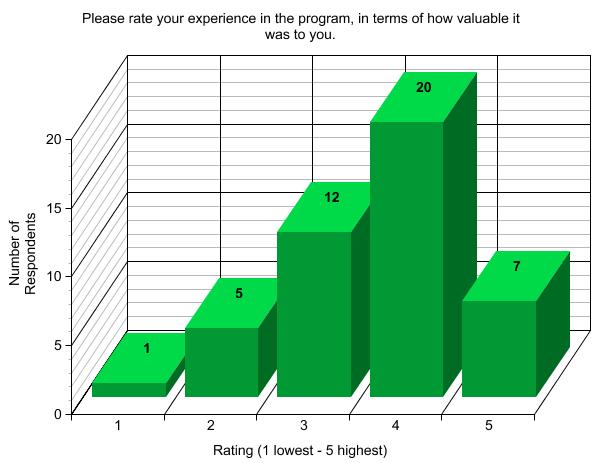
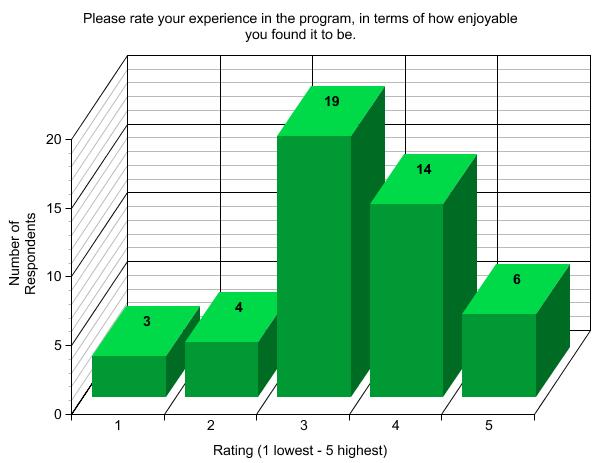
There were 46 respondents, divided roughly by year with 57% of respondents identifying as members of the 2008 Emerging Leaders class, and 43% from the 2007 class. Overall, the results to the ratings questions were positive. When asked to rate the value of their experience on a 1-5 scale, with 5 being highest, 60% of respondents rated the program as a 4 or 5. When rating their experience based upon how much they enjoyed it the ratings were slightly lower, with 43% rating the program as a 4 or 5. However, an additional 41% rated the program at the midpoint level of 3. As an additional indicator of the perceived overall value of the program, 61% of respondents indicated that they would recommend Emerging Leaders to others. 78% (36 respondents) felt that the program made a difference in the trajectory of their career and/or ALA involvement. The great majority described a positive impact; only 3 of those respondents indicated a negative impact in that the program discouraged them from continuing in ALA.
The responses to the open-ended questions were far more mixed, and will be described in the following sections of this post.
Worthwhile aspects
Overwhelmingly, survey respondents pointed to networking as the most rewarding part of their Emerging Leaders experience. Out of 38 who answered the question, “What aspects of the program did you find worthwhile, if any?,” twenty-five referred to “networking,” “making new friends,” and/or “meeting people” as a positive result of their participation. One respondent described “meeting other enthusiastic librarians” as a worthwhile part of their experience. Another simply answered, “Networking, networking, networking.”
Similarly, an additional seven respondents pointed to their group work, in terms of having the opportunity to work with and get to know a small group of people, as a worthwhile aspect of the program. One respondent explained it this way: “Working in small groups was a real plus. I probably would never have met my groupmates through any other channel, and it is great to see them at conferences and catch up.”
Eleven respondents indicated that the most worthwhile part of Emerging Leaders was the doors the program opened for them in terms of committee work, recognition, and resulting presentation and publication opportunities. In the words of one respondent, “The recognition I received from other conference attendees because of my EL ribbon on my name badge was surprising to me…. Just wearing the ribbon served as a conversation starter and the networking opportunities are there for the taking. The opportunity to continue working at the national level upon the completion of the program is the greatest benefit.”
Another respondent commented that it was “a great way to become more involved when getting your foot in the door seems intimidating.”
I agree strongly with these assessments. Being handed the opportunity to meet so many like-minded librarians who share my passion and desire to make positive contributions to the field was a stunning experience. Granted not every EL was quite that driven — I do know that a few dropped out along the way — but the vast majority of the librarians I met through Emerging Leaders are impressive individuals, and I have continued to stay in touch with many of them through email, Facebook, and this blog. I cannot overstate the value of the Emerging Leaders networking experience.
Disappointments
Out of 39 who responded to the question, “What aspects of the program did you find disappointing, if any?,” eighteen indicated some aspect of the conference workshops, and another fourteen pointed to their group projects. Specific comments about the workshops varied, although many expressed the wish that there had been less lecture, more interactive sessions, and more advanced leadership training. “Really expected to have more ‘leadership’ training,” said one respondent, “similar to ARL’s leadership workshops, with in-depth discussion and activities around aspects of leadership in a library organization. Found that it was little more than ‘here are 5 qualities of good leaders.’” Others described the content of the leadership training workshops as “rudimentary,” “weak,” or “trite.”
Additionally, several respondents felt that those facilitating the workshops were not responsive to their ideas and feedback. As one respondent explained, “The ALA leadership that spoke to us regarding what can ALA do to enhance or encourage more participation by newer librarians – when we provided feedback and comments in an open forum – I got the distinct impression that there was not an interest in new ideas. Rather they were looking for confirmation that what steps they were already taking were satisfactory. There wasn’t an opportunity for a free exchange of ideas between the old guard and the new guard.”
Another observed, “You have a room full of folks who are energized and the energy didn’t go anywhere.” This sentiment was repeated throughout the survey responses.
A large number of respondents felt that their group projects were “busy work” and did not see that their efforts were providing any results. “Emerging leaders participants do a lot of good work for the projects,” said one respondent. “I was disappointed that the work was not used more within the ALA system. While doing the project for project’s sake provides good training experience, the outcomes can be useful for the organization.” Others compared the projects to “another library school assignment” or evaluated them as “not all that engaging or useful.”
Overall, my own greatest disappointment in the program was being encouraged to offer creative ideas and feedback in the interests of effecting change within ALA, and then watching the bubble burst over and over again. Whether it was a conversation about how to make ALA more responsive to new librarians, or the “World Cafe” events in which we brainstormed what the ideal organization would look like, our collective vision was praised, collected, and (I imagine) filed away at the end of the session, with no opportunities to further develop or pursue it.
Alternative visions
In response to the question, “If you were asked to take over the Emerging Leaders program, or to create a new program to foster leadership among new librarians, what would it look like?,” past ELs had a variety of relevant ideas and suggestions. Regarding the content of Emerging Leaders workshops, respondent comments generally focused on three primary issues they would address. First, they would emphasize interactive leadership training as the program’s primary goal and reduce the emphasis on generating greater ALA participation. As one respondent stated, “it would have a larger goal than putting participants ‘on the fast track to ALA leadership.’ I think it should focus on helping participants attain their personal and professional best and how ALA can help them get there.”
Second, respondents disliked the current lecture-based format and many indicated that they would incorporate active learning exercises and guided small group discussions moderated by experienced ALA members. Third, many would add a variety of inspirational and “Mover and Shaker”-type guest speakers from within and outside of ALA whose experiences and knowledge would be relevant to ELs. Several suggested creating venues to facilitate free and open discussion among and between Emerging Leaders and those at various levels of ALA leadership. One respondent had a clear vision of a potential format they would institute: “Instead of posing organizational change questions to the group as a whole I would offer Issues Discussion Tables, letting participants choose the issues most important to them and to which they feel they can offer definite courses for change. Issues Tables might include: ALA Structure, ALA Student Chapter Solutions, Virtual Membership, etc. A 1.5 hour session with a mentor/moderator could provide real, progressive ideas.”
In terms of program format, many respondents would develop intensive training programs that included week-long retreats or a year-long, involved program with multiple meetings at each conference and ongoing virtual participation. One respondent summed it up, “It would have to be more involved. More than just 2 meetings. More virtual participation, discussion.” Many respondents thought an ideal class size for a leadership program would be small (one suggested a class size of 50 participants). Consistent with this, many felt that such a program should be highly selective, accepting only candidates with the clearest leadership potential.
Some respondents favored incorporating a mentoring program, possibly by having past ELs mentor subsequent participants or groups, or by holding “tours” of high-level ALA meetings for participants. Many emphasized the need for communication and community building activities among EL participants and alumni, such as an online community and/or regional meetups for ELs (or projects assigned by region) that provide networking and development benefits without required conference attendance.
Among those who would include group projects, respondents indicated that those projects would be designed to have clear relevance, impact, and purpose within ALA, and provide room for innovation. “I’d give the young/new librarians more room to innovate in their projects instead of assigning them grunt work from the various divisions,” said one respondent. Some suggested models in which ELs identify and design their own projects, are fully integrated into existing committees, or are employed as interns at high levels of ALA structure. Others believed that group work interfered with the leadership training goals, and could be omitted altogether in favor of other activities.
An alternative vision proposed that differed somewhat from the others was stated thus, “Why have the program if the only benefit is to get a committee appointment? Just have a program to get people on committees.” Others mentioned BIGWIG and an unspecified AASL program (perhaps the Collaborative Leadership Institute?) as models they would draw on.
From my experience in the program, I can attest that there was quite a bit of grumbling amongst the ELs during the full-day sessions at each conference. The majority of ELs are borderline or full-fledged Millennials, and being “talked at” is not a way we effectively learn. And while we can learn through lecture if we must, the content in our sessions assumed that we knew very little about leadership or interpersonal skills in general, which was largely untrue. A higher level of content and more skill-based activities would have greatly enriched the sessions for many of us.

Discussion
Clearly Emerging Leaders is generating widely differing reactions among participants. Some of the responses are extremely positive, and many past ELs express gratitude and pleasure for having had the opportunity to participate. One respondent asserted, “being an EL has changed my life…. It was a great way for me to get involved in a career that I truly love.” Others made similarly glowing statements. Meanwhile, other past ELs say they have become “embittered” and describe the program as “a waste of time.” My personal response to the experience was mixed; as a whole I found the experience rewarding but like many others I was frustrated by some of the elements of the program that didn’t fulfill my hopes for what it could be.
At its root, much of my own and the survey respondents’ frustration with Emerging Leaders may derive from a discrepancy between our expectations and the reality of the program. Comments from many of the respondents indicate that they began the program with the hope of making a difference by bringing their new ideas and energy to ALA, but felt that they were not offered an effective venue to do so. One respondent acknowledged that discrepancy, saying, “I would recommend the program with a huge qualification regarding expectations and outcomes.” Implicit in this comment is an indication that their expectations for the program were too high, at least compared to the reality of the experience.
From what I have seen, there is a direct connection between those individuals who are most passionate about making a positive difference in libraries and those who are most frustrated by the Emerging Leaders program. The frustration is a product of feeling that their EL experience was something akin to standing in a doorway, enjoying a spectacular vision of the future, and having the door slammed in their faces. Said one respondent, “I felt a great disconnect with the leadership of ALA and have concerns for the professional organization and what current leadership is doing to pave the way for new ideas.” Another respondent echoed those concerns and took a step further: “I am not sure…that we are making much of a difference within ALA. We had many ideas, but nothing has been done with them. Perhaps we need to extend the program to a post piece that deals with the ideas that we’ve come up with and creating a strategic plan on how to implement them.”
If one were to make change to the Emerging Leaders program based upon this feedback, there are two potential paths that could lead to a more satisfying experience for participants. The first is to simply remove the elements of the program that give participants the impression that their creative ideas for remaking ALA are welcome and to focus on the skills specific to leadership instead. Discussions and brainstorming sessions about how to improve the organization could be removed from the program in favor of an increased focus on leadership overall. This approach would eliminate the disappointment caused by ELs feeling that their creative ideas were invited and then discarded.
The alternative path is far more complex but arguably more exciting. It would require the organizers of Emerging Leaders, and the ELs by extension, to become more aggressive in seeking out opportunities in which ELs might share their creative ideas with those in ALA who are best positioned to consider and respond to them. It might involve having a group of ELs write a proposal to ALA Council on some pressing issue. It could tie certain ELs to current ALA presidential initiatives, or other high-level committees and task forces. Or perhaps at the end of each program year, it would involve ELs presenting a list of ideas and/or proposals to representatives of current ALA leadership. Perhaps ELs could work on more meaningful, longer-term projects they would hand off each year to the next group of participants. Above all, it demands enabling ELs to begin putting into motion some of the creative ideas they are generating in workshop sessions. There are many potential ways to offer ELs the sort of exposure and feedback that survey respondents indicate they are seeking; the point is to start building those bridges.
What do you think? I invite my fellow ELs to add your insights and comments below. In this post I am only beginning to dig toward the root of the issue, and maybe with your help we can bring it out into the light. Perhaps the true movement toward change that comes out of Emerging Leaders doesn’t have anything to do with the program at all — perhaps it is made by those of us who have come together out of the program inspired, furious, motivated, and passionate with a network of colleagues who feel the same way. After all, that is the spirit behind In the Library with the Lead Pipe; it is not a coincidence that five members of our blogging team are past ELs. And as we move forward in our careers we carry with us that nearly religious belief in change, and the knowledge we need to make it happen. Perhaps, in the end, we are the change we wish to see.
Appendix: Survey Questions
- What year were you an Emerging Leader? (multiple choice)
- Please describe your overall experience in the Emerging Leaders program. (open-ended)
- Please rate your experience in the program, in terms of how valuable it was to you. (rating, 1-5)
- Please rate your experience in the program, in terms of how enjoyable you found it to be. (rating, 1-5)
- What aspects of the program did you find worthwhile, if any? (open-ended)
- What aspects of the program did you find disappointing, if any? (open-ended)
- Has the Emerging Leaders program made a difference in the trajectory of your ALA participation and/or your career? (multiple choice)
- If you answered “yes” to the previous question, how has it made a difference? (open-ended)
- If you were asked to take over the Emerging Leaders program, or to create a new program to foster leadership among new librarians, what would it look like? (open-ended)
- How likely are you to recommend the Emerging Leaders program to others? (rating, 1-5)
- Is there anything else you’d like to share regarding your experience as an Emerging Leader? (open-ended)
Many thanks to everyone on ItLwtLP for help in crafting the survey and drafting this post, to the many ELs who took the time to respond to the survey, to Latanya Jenkins for her thoughtful feedback on a draft, and to Derik Badman for reviewing multiple drafts and providing me with some small (but needed) kicks in the butt.
Pingback : L1BRAR1AN › Survey of ALA Emerging Leaders
Thanks for putting all the work into doing this, Kim. I know it’s been one of those issues floating around since we started ItLwtLP.
I can’t say I was surprised to discover my responses to your survey were on the negative side of average, but I am in wholehearted agreement with the networking as positive aspect. I’d almost just vote to make it the Emerging Leaders Social Club (sounds exclusive and snooty, though).
I’ll also admit to being one of the people who said that the program negatively affected my desire to participate in ALA. The hard sell at times during the program was a real turn-off (like going to the timeshare lecture to get a free vacation), as well as the oft-noted lack of real response to much of our work or comments. I have no idea what become of the group project I worked on. I literally have heard nothing about it since that Friday at Annual. Not even a “thanks for the effort” from the appropriate organizational group.
The “get on committees” bonus of EL has also not aided my desire to participate, as I’ve gotten on some committees that apparently do nothing. Another line for the c.v. and nothing more, which, so far, (with the exception of meeting a few great people) holds true for the EL program.
Congratulations, Kim, for being able to remain (relatively) unemotional about the EL experience. I remain highly emotional and frustrated by a lot of my EL experiences.
When I was put on a committee because I was an EL, I tried to attend that committee’s meeting at Annual prior to my official start as a member (as scheduled in the conference planner) and no one was there. The meeting had been canceled and I didn’t know it.
Another of the issues is that borne out of the work of my EL group project a task force was created and I was happy to be a part of that task force, but for some reason the task force got disbanded (I still don’t know why) and our work and report stored away somewhere.
I do have to say that I was lucky to be in a group that had excellent group project mentors. It’s just too bad the project and all of our energy went seemingly nowhere.
Another issue that still burns me is that I took the effort after our last workshop to speak with one of the workshop organizers and discuss what I thought might make the workshops more fruitful. I suggested making a leadership challenge of the workshop day. Or a group challenge, something interactive. Speaking with participants of the following year’s EL group, none of those suggestions had been implemented. I felt like I was doing a good thing by offering my feedback in person. I didn’t want the next class to have such a negative experience in the workshop times as I had.
Thanks for doing such a great job getting some data while also feeling okay expressing your feelings. While ALA is definitely not as much of a Kool-Aid drinking place as other library vendors can be, I still get the feeling that they’ve learned how to talk to the talk of openness without really being able to walk the walk.
Whether this is due to structure, individual people, or their bogged down org structure, I’m not totally sure, but I also felt when I was on Council [maybe I need to do a post about that…] that people wantd to say they had younger people with new ideas on Council but they really didn’t want to use that in any way shape or form and there was so much talk about “paying dues” and free speech meaning that people got to abuse other people on the mailing list, that I decided to work more locally to effect real, if smaller, changes.
I wrote about Emerging Leaders during the application process last year–almost exactly a year ago. At the time I was critical of the entire organization for the way non MLS library workers who are also dues paying ALA members are excluded from opportunities like EL.
As a first year ALA member I was ready to cut the cord with ALA. I am so thankful for the wonderful advice and coaching given to me by Pete Bromberg who suggested that rather than complain or protest ALA policies that I actually get involved.
So much has happened within a year. Thanks to many, many people who supported the cause Emerging Leaders will be expanding the requirements for application this year to include those without an MLS, those still in school, and even those between jobs.
My point here in a round about way is if people have ideas to improve things within ALA (or anywhere else) they need to speak up – like you are doing here Kim. Things cannot change if people are not willing to stand up and be part of making the change happen.
I know from my own personal experience that everyone involved in EL would be open to any constructive feedback about the program. I think that every program should strive to improve and I hope to see EL continue to grow and expand and provide meaningful opportunities for people to get involved with ALA.
My memory fails me after all this time… was there ever an active attempt to get feedback from EL members? I think I remember such, but… can anyone confirm/deny this?
Seems like a pretty new program–only three classes so far, including the current one? I would think a project like this would take a lot of work to get off the ground, and that failing in the first few go-rounds would be pretty much par for the course. Then again, in order for failure to be productive, you have to be willing to acknowledge and learn and change from it. It’s disturbing to hear that feedback is neither sought nor much used. But in my experience, institutions move glacially if at all, so perhaps this is something that will change with time?
My only cringer thing here is the idea that emerging leaders are all people chosen for Emerging Leaders. In order to participate at all you have to pay dues to ALA and then pay to attend two conferences. That means only the rich kids can play, right?
Thanks for a thoughtful and interesting post. I am in the EL Class of 2009 and I can relate to many of the issues raised here.
My team has been charged with developing a robust community for past and present ELs. You can read about our team charge here: http://wikis.ala.org/emergingleaders/index.php/Project_V_(2009).
Our response to our group charge is to propose EL interest group within the ALA structure. One function of the interest group will be to provide a feedback loop between ELs and the program administrators. We also hope that the interest group will have some sort of role in project and liaison selection. We are hopeful that our proposed interest group will address some of the issues many ELs are reporting.
I also want to note that our team was provided with results from a survey administered to ELs, and we carefully reviewed the survey feedback and considered it when thinking about how to approach our group’s project.
Sorry, try this for the link. Team V, Class of 2009.
Kim,
Thanks for all of your time and effort in putting this blog post together. I’d like to offer my comments as someone who has been involved with the planning and execution of the Emerging Leaders program. I’m speaking only for myself, not the EL Planning Committee.
First, the data you’ve generated and thoughts that you’ve expressed mirror the feedback that we’ve gotten from our surveys of the Emerging Leaders. (Derik, I have 2008 survey data–I think there is 2007 data also, but I don’t have it, so I don’t know for sure.)
I am in agreement with many of the points, and have advocated (and will continue to advocate and do what I can to see implemented) with these points in particular:
1) That the program would benefit from more online contact (i.e. webinars) between January and July. These webinars would give the EL’s a chance to meet and network, and they could be organized around specific leadership topics, and led by noted library leaders.
2) That the projects are problematic, and this model needs to be rethought and refined to avoid, at all costs, busywork. If the projects can be designed to be useful to the EL’s AND ALA, great. If not, they need to go…
3) That there is a disconnect between what the EL’s expect and what the program provides. I think the program has tried to clarify the expectations each year. I think the program needs to not just clarify, but actually *shift* in the direction of meeting the needs/desires/expectations of the participants. If this happens, the payoff for ALA will be tenfold.
4) That there needs to be more opportunity for EL’s to connect with each other. To this end I proposed a project for one of this year’s groups to ” to create a robust community of Emerging Leaders Graduates that facilitates ongoing contact, networking, learning, sharing, and development around issues of leadership in the Association and in the broader profession”. This project was accepted and is being brought to life (http://wikis.ala.org/emergingleaders/index.php/Project_V_(2009) and mentored by an Emerging Leader from 2007, Michelle Boule.
File this next bit under, “not to make excuses, but…”
The Emerging Leaders program is a huge undertaking, and it is run by a few people of good will who also have day jobs and (and I can’t stress this point enough) are up against the *very same challenges* that the Emerging Leader participants are up against in trying to run the program in an effective and efficient manner that meets the needs of the oh-so-many-stakeholders. It is, as most things are, an exercise in the art of the possible.
I love ALA. But let’s face it, it’s a big, slow-moving, sometimes not-very-responsive organization. Those of us who work at planning, creating, and executing the program are often up against the same constraints that you are.
So my question is, what can we do together to make this program work better? It’s an easy question to ask, it’s a harder question to answer. Lori Reed (in her comment) mentions that I called her up a year or so ago and in her words, “suggested that rather than complain or protest ALA policies that I actually get involved”. My recollection of what I said is what I will now repeat to you Kim, and any other Emerging Leaders who want to make a difference: What outcome would you like to see, and what specific, concrete steps can you take to move things in the right direction? What actions can you take, to make it more likely rather than less likely that the Emerging Leaders program will become what you want it to be–what it could be–what it should be?
Asking and answering those questions is the heart of strategic thinking and strategic action. It is the heart of leadership. I understand the frustration–believe me, I understand it. But the frustration has to be the beginning, not the end. The frustration is the tension, the creative energy, we feel when there is a gap between what we see and experience and what we know we could See and Experience.
So if you’re feeling that frustration, I ask you to please use it as a launching pad, and harness it to help make the Emerging Leaders program better. The survey and the blog post are a great start. But if it ends here–well, then wouldn’t that just be re-creating a similar situation to the “World Café”, where your opinions were solicited but then you felt that nothing was *done* with them? Well, you’ve generated some data here. Now what are you going to do with it?
My hope is that your blog post will generate enough attention and energy that it will lead to more of a creative partnership between you, other Emerging Leaders, and the Emerging Leaders Committee, and will result in a more informed program that better meets the needs of former, current, and future participants.
Thanks again for taking the time to put this post together, and for (yes) your courage in candidly sharing your views.
I appreciate reading your post and everyone’s comments. As a member of the Exec board, I sometimes hear that an EL group is working on a project and I know I’ve been pleased to anticipate the results. Yet, I can’t say that I’ve seen the results of any projects. I’m not sure where all the projects go but your conversation here has raised my level of questioning and I’ll be finding out soon. I’ve been to the wikis and various project pages, but I don’t see the final projects. How are these coordinated? Who in leadership is everyone referring? I would like to learn more. Thanks for working so hard on the post.
Diane Chen
The 2009 ELs will be presenting posters about the projects they have been working on over the past year at ALA in Chicago. The poster session is open to the public:
Friday, July 10, 2009
3:00pm – 5:00pm
McCormick Place West – Room W-185
Kim —
I don’t know where to begin. Maybe first with thanks for your post and for the work you did to get there. I don’t want to dissect what you wrote and respond accordingly because I don’t know enough about the EL program to do so (either as a participant or as a planner). What I will do is respond to 2 thoughts that stuck in my mind during and after reading your post. (Identifying the 2 thoughts doesn’t mean that other ideas/comments in your post were not important.) Those 2 thoughts were “expectations” (a negative)and “networking (a positive).”
I understand that there might be nothing more frustrating about something – a program, a process,etc. – than when it appears the “expectations” have not been met for whatever reasons. What I read was that some ELs felt that what they understood about the intent of the program (expectations)was not what they experienced (frustrations). I am hoping that your post will be read by folks involved in the planning of the EL program (and thanks, Peter B., for posting your comments). Not being involved in the EL program, I am only sharing my observations here solely based on your post and the comments.
The other thought is networking. Let’s not underestimate the importance of networking as a leadership skill. To do successful networking is to help one’s career. But with successful networking comes developing a strong/solid reputation (such as: the person contributes, follows through, does quality work, is reliable, brings integrity, works well with others, etc etc etc) I write this because reputation can either make or break a successful network. As I read your post, it appears to me that one of the most positive outcomes of the EL program was the networking. I challenge EL graduates to continue to build a strong network and not just with folks who think like you but also with folks who make you think.
Let me just end my post 1) with how excited I was when I first heard about the EL program, and how envious I was that I didn’t have something like that early on in my ALA “life;” and 2) with a comment you made early on that struck me — “…there is a significant gap between the inspiring, boundless encouragement given to ELs to reenvision ALA and the reality of how change might actually happen within the organization. I am proud to have been an Emerging Leader and I hope that this post may be the start of some small movement to improve what is, at its heart, a truly impressive initiative.” Good for you! Kim, your survey (as you mentioned, not a random sample) is at least a start where we are dealing with more than anecdotal information.
I wish you and the other ELs all the best and again, hope/encourage you all to work (however big or however small)with ALA.
Well, you’ve generated some data here. Now what are you going to do with it?
I’m uncomfortable with the idea that a well researched and presented critique, like Kim’s, is accompanied by additional requirements.
As Pete wrote above, “What can we do together to make this program work better” is “an easy question to ask,” and it’s an appropriate response for the personally delivered suggestions Emily Ford described in her comment. It’s a shame that whoever listened to Emily’s suggestions didn’t ask her to help implement them, and that Emily was surprised and disappointed to learn, a year later, that her suggestions hadn’t resulted in the changes she believed she had inspired.
Kim’s situation is different. In researching and writing this article, Kim’s done her part. Sure, it would be very cool if Kim’s willing to help further, and I suspect that she is, but when someone does what Kim’s done here we need to be grateful, full stop.
Gratitude is hard. Especially when we’re working our tails off for ALA, mostly on our own time, and people tell us we should be doing more or doing things differently. Working for ALA isn’t easy: ALA is huge and chaotic, it underfunds ambitious projects, it relies on volunteers, etc. This probably isn’t ALA’s fault; it’s likely inevitable given the economics of librarianship. Despite these limitations, I think there are things we can do, especially when we’re helping to represent ALA:
1. We can focus on operating more transparently. If you have data, share as much of it as you possibly can. When it doubt, err on the side of sharing.
2. We can solicit and implement suggestions. When you start a new project, build a feedback mechanism into it. One of the many things ALA can learn from code4lib is voting; code4lib participants vote on everything.
3. We can offer unqualified gratitude to anyone who provides us with well researched and presented critiques, even though it’s really, really hard. For inspiration, I like to think of a story by Richard Dawkins:
Emily: I don’t think anyone else has addressed your comment so I guess will.
The idea is that “Emerging Leaders” are all people chosen for Emerging Leaders. I don’t think there’s any claim of exhausting the potential/emerging leaders out there.
Also, there were a number (large?) of ELs whose conference attendence was partially (wholely?) funded by different parts of ALA. And I’d imagine many of the rest of us where also partially (wholely?) funded by our institutions.
So, not necessarily all rich kids. I’d imagine/hope that the ALA sponsoring groups looked at financial need as one criterion for who they funded.
Glad Maria posted about Team V’s project. I, too, am an EL 09 (Group G ).
Kim: thank you for such a well crafted post–Hilary and I briefly discussed the need for one at Midwinter.
It resonated on. many. levels.
Glad Maria posted about Team V’s project. I, too, am in the EL class of 2009 (Group G). Hilary and I briefly discussed the need for an honest, well crafted post at Midwinter, thanks for making it happen!
It resonated on. so. many. levels.
Emily/Derik – I remember my year we were told they were accepting 120 people, 60 would be sponsored (via a $1000 stipend from various specific subgroups) and 60 would not.
I was lucky enough to receive one of the sponsorships (mine was from ACRL’s CJCLS). Sponsored ELs were then assigned to the project of their sponsoring organization. You could make your case for sponsorship both in your application and separately to organizations you knew to be involved in sponsorships.
My home library then supplemented that sponsorship to help defray more (but not all) of the costs. There were also some EL’s whose home libraries covered some or all of their expenses and others who did have to pay for everything out of their own pocket. I don’t have a sense for how those percentages would break down.
So I would say it’s not limited to the rich kids, but that you still very much have a point in that it probably does trend towards including more people who are willing to make the effort to obtain funding (either through sponsorships, their home institution, or their own pockets) to pay dues and attend 2 conferences yearly (not just their EL year). Since one of the stated goals is to get people more involved in ALA at higher levels, it would make sense that they want to recruit potential leaders who can commit to the current 2 conference a year structure.
However, I hope that they are reevaluating that structure, acknowledging what a financial burden that is to many of us (especially as libraries cut their travel budgets) and looking for more ways to allow for virtual participation. I was very pleased that both of the committees that I was appointed to after being an EL still accepted me when my reply was that I would be willing to come to Annual, but could not afford to also attend Midwinter.
Brett – Thank you very much for that well said reply. And thank you Kim for this wonderful article and the underlying research.
Kim – you have done an outstanding job of describing the Emerging Leaders program! Your careful evaluation brings to light many issues that any library association should take to heart. You provided thoughtful suggestions for restructuring the program and you should be commended for your work. As you wrote and as the comments confirmed, just about the only positive outcome (in my experience of being in the 2009 class) was meeting other Emerging Leaders and talking to them about issues that transcend ALA. This was what I expected the program to be about, and yet, these meaningful experiences happened outside of the program itself.
The project that I was assigned was one that fell in the class of busywork that an undergrad/high school student could have done. It took not much longer than 40 hours to complete from start to finish and did not lend itself to group/team work. FWIW, the final report of the project is on the 2009 EL wiki. It’s going to be up to the mentoring division to carry it forward, however, it is my impression that the division that proposed this project has already carried out and accomplished the goals it set forth prior to this project being taken on by our group.
I fully support the suggestions that the EL program should be smaller and more immersive (20-30 participants/year) with a focus on enabling ELs to engage in high-impact, strategic initiatives. There are many Fellowship programs on which to model a successful program (the NCSU Libraries Fellows program being one). ALA should ensure funding for all ELs and could be better positioned to do so by capping out the number of participants at 20-30.
While I don’t doubt that the organizers are doing their best to juggle their own jobs, personal lives, and want to make the EL program meaningful, it’s my impression that ALA isn’t providing the support necessary to make the program significant for “growing the profession” and developing leadership skills. Thus, the fallback position of the program attempting to be a matchmaker for ALA committees and new-ish library professionals. It’s an easy way out for what appears on the surface to be an under-supported program.
One of the most striking comments that was made at the January 2009 EL session was from one of the speakers who introduced us to the program by sharing stories about ALA’s massive bureaucracy and the tremendous difficulty in making things happen. She suggested that taking a break from ALA was one of the strategies that worked for her. “There have been times when I couldn’t stand to come to these conferences.” It’s possible that some ELs will (and have) followed her advice already.
RE the money issue. The EL program isn’t for “rich kids.” Yes, there ARE inequities about it.
I was not sponsored by a division to be an Emerging Leader the year I participated. In fact, I was unemployed when I was accepted into the program. Attending both conferences without institutional support (I got a job before the first conference) I put myself into (further) credit card debt to go.
All-in-all I think that this choice led me to be more disappointed in the program; after all, I did spend around $4000 in one year to attend conferences and be a part of the program.
This choice gets at a great point Kim made: our expectations of the program. I think my expectations were higher for the program because I had to shell out so much cash to be a part of it.
So why did I make the choice? A few reasons. First, the job market for librarians in my town is pretty bad. It’s saturated by students graduating from distance cohorts hosted here. I wanted the edge to get a job. Second, I though the program was going to be worthwhile. And it wasn’t $4000 worthwhile. Hence, the emotional aspect.
What a flood of feedback! Thanks, everyone, for your thoughtful and sincere responses to the post, and to the many who emailed me as well. It’s clear that a lot of people have a lot of investment in Emerging Leaders. I think that’s an important place to start as it’s the common ground we all share, no matter what our role in the program. The fact that we feel so strongly about EL is a sign that we want the program to succeed.
I am starting to wonder if the root issue may be, at least in part, a basic gap in communication between those involved in EL at different levels. As Emily points out in her comment, the program is brand new, and we should all be willing to endure some growing pains. Of course, if those who plan and execute the program are aware of the pains, shouldn’t the program be improving and evolving each year? And if there is an effort to improve the program, shouldn’t past ELs be involved, or at least informed? We might even be able to help.
Perhaps there is also the generation gap factor, as Jessamyn referred to above in describing her experience on Council. Do we need to put our time in before we can have a voice? I don’t think it needs to be that way, and nor do many of the established ALA’ers I know. Still, I think we all know those in in ALA who are comfortable with the status quo.
Change can’t happen overnight, granted, but many of us — like Lori Reed — are starting to make a difference. An EL interest group, suggested above by Maria, could help, and I hope it will be closely integrated with the activities of those who plan the EL program each year. Otherwise it runs the risk of becoming just another silo of exciting but unproductive activity.
So we have opened the door to positive change in Emerging Leaders, and now we must see it through! I want to thank those from the planning side of EL who have responded in the comments above and emailed me. Apparently the planning task force will meet in an open meeting at Annual on Sunday at 1:30pm (I am told it will be at McCormick Place, Room W175A). I, for one, am planning to be there, and I hope other past ELs who are able to be in Chicago will be there too.
Your continued comments on this post are welcome. This is a discussion that is going somewhere, I think…
Interesting post. I appreciate that you surveyed your fellow EL participants to obtain a broader perspective.
Although I have not participated in the EL program, I think you hit on a core issue that affects more than just ALA when you said “…there is a significant gap between the inspiring, boundless encouragement given…to re-envision…and the reality of how change might actually happen within the organization.”
I liked your suggestion to have ALA focus more on general leadership skills, etc., if they really didn’t want feedback. Perhaps the larger library community could consider this concept as well. It is very frustrating to have energy and ideas and continually have them not be put to any fruitful use. Eventually the ideas and energy (or at least the desire to contribute them) will cease, which technically is the opposite of what ALA (or libraries in general) say that they want. I find the tension in this dynamic interesting, but frustrating. Thanks for bringing light to it and for your thoughtful observations.
Kim has a new idea, Kim shows initiative, Kim conducts research, Kim reports findings, Kim shares her information with others.
Kim is getting buried under the weight of this thread.
Laura Z. make a good observation I am interested to learn more about the perceived tension in the dynamic.
I, too, would like to respond specifically to the following statement,
“…I believe that there is a significant gap between the inspiring, boundless encouragement given to ELs to reenvision ALA and the reality of how change might actually happen within the organization.”
It’s really something I picked up on throughout the article, but I think this statement really captures my own frustrations. It’s not specific to the Emerging Leaders program, but rather a frustration I feel as a newer member of ALA Council. There is such energy and passion for wanting to assist in positive change for the organization, but it often feels like we encounter roadblock after roadblock in the journey to do so.
It is right to encourage patience, but the suggestion wears thin after a time and the cry for patience starts to feel like an excuse to resist moving ahead. I don’t know what creates it as there are times I see a real desire to move the organization forward, but alongside that desire are some very piercing cries against the movement.
I find it difficult and painful to keep my energy positive in that kind of environment, and I worry that, as a result, newer leaders in ALA will burn out far quicker than ALA is used to. I passed a link along elsewhere urging those interested in ALA’s future and leadership to read this article. While the topic at hand here is the EL program, I think it speaks to a much larger issue facing ALA these days.
Thanks, Kim, for writing this and inspiring such thoughtful conversation for us all.