


[RE]Boot Camp: Share Some. Learn More. Teach Better.
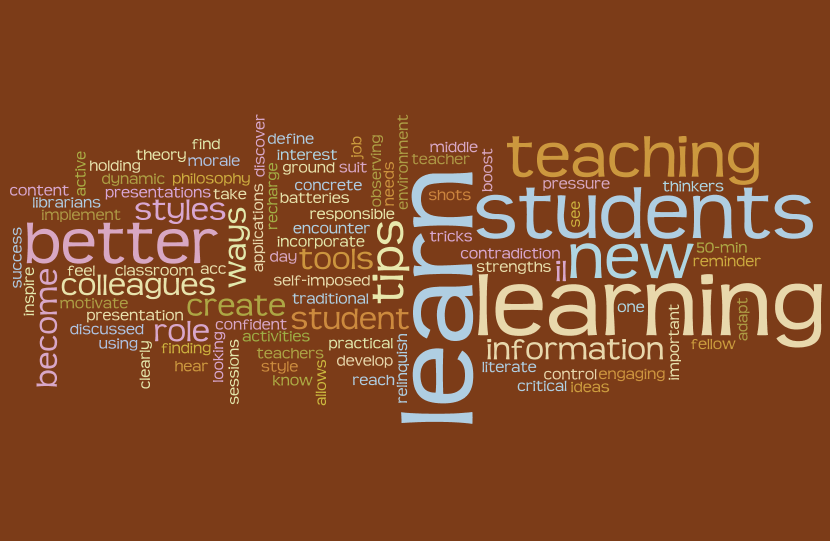
Wordle cloud of participants’ goals
Setting the Stage
Last fall, as a part of the Texas Library Association’s “Transforming” initiative, my library held its own transforming retreat. Austin Community College (ACC) Library Services has gone through a hiring spurt recently, adding 10 new full time librarians in just the last three years. This retreat brought together all 23 of us from across our seven campuses. We were told to bring any and all wild creative ideas. As is so often the case, we also brought some fairly practical ones. One of these was a request for training on how to teach. This came both from new librarians with no formal training in instruction and from veteran librarians who were interested in learning the current theories and best practices.
As a result, during the Spring semester of this year our dean, Dr. Julie Todaro, called a group of us together to begin planning an immersive teaching training program, aimed primarily at the newer librarians to get them comfortable and up to speed. After the initial brainstorming session (which was comprised mostly of the newest hires), a smaller group (with a higher ratio of more seasoned librarians) was designated as the planning team. This included three members of our Teaching Team, our Public Relations Facilitator and myself (as the representative from the Staff Development Team).
This post will walk you through our process in the hopes that you will find both inspiration and information to help you create your own training programs.
Getting the Team Together
The first step was assembling the planning team. While I wasn’t a part of this process, I can tell you some of the obvious considerations.
Do you have staff with relevant experience or expertise? Two members of our planning team had been through ACRL’s Immersion Program.
Does your library already have teams or committees that focus on certain areas? At ACC we are one library spread across seven campuses and (with a few exceptions) all of us hold the title Reference Librarian. Rather than having titled positions in charge of the various aspects of daily library life, each librarian is a member of at least one cross campus team. I am co-chair of the Staff Development Team, which is charged with identifying professional development needs and providing access to appropriate training. Our Teaching Team focuses on information literacy instruction. In addition to coordinating study guides and interaction with faculty, one of its many charges is to identify relevant information literacy training and development curriculum and coordinate librarians’ participation in these opportunities. Our PR Facilitator was also included in the planning team. Her initial inclusion was based on her past participation in the ACRL Immersion program, but as I’ll discuss later, it was incredibly beneficial to have someone who was able to contribute experience in marketing and event planning.
Planning and Decision Making
We started with some of the basics already assigned to us. For example, you will need to consider what you want your focus to be. We concentrated on pedagogy and theory. This was to be a grounding in the current understanding of teaching and learning and accompanying best practices. This was not the place for discussing our library’s programs and practices (although we did design a follow up forum for exactly that purpose). You will need to determine who should participate. Ideas that floated around in our discussions included: making it completely voluntary, requiring applications, and making it mandatory for everyone. Ours was open to all librarians but mandatory for the librarians who had been with the college for less than 5 years. For us, that turned out to be 12 participants plus two facilitators whose professional experience varied by decades – a good mix!
With our focus and audience selected, the team met to begin brainstorming, breaking down topics and creating timelines. We contacted colleagues at other institutions to find out if they had done anything similar and what their process had been. We read through syllabi and handouts from workshops, seminars and new faculty orientations.
We debated how much time we should devote to the program and settled on two days. We felt one day wasn’t enough time to cover everything we wanted to, but more than two days would be difficult for staffing and scheduling. We also struggled with when to hold the training. We had originally thought early August would be a good and relatively slow time, but realized some librarians would be off contract. However, if we postponed until the fall semester it would have a large effect on reference desk coverage. My campus, for example, had all three of our full time librarians in the required attendance category. Based on those two factors, we decided that the first week of the librarians’ return from summer session, which is also the week before classes start for the fall semester, although not perfect, would be the best possible time available to us and allow the most librarians the chance to participate.
Our next decision point was where to hold the camp. We considered our state library association’s facilities, our business center’s training rooms, and campus activity rooms. A high priority was that the atmosphere should evoke a feeling of being ‘away from the library’ so as to encourage the immersion experience. My vote went to my favorite faculty lounge, the one with the wood panel walls, comfy chairs and great views. As a much more welcoming place to spend our time, this is where we ended up.

Presenter AJ Johnson
Moving from logistics into content, one thing that emerged fairly early was the idea of a culminating activity. We felt that it is important to provide an opportunity for the participants to immediately practice the skills they had learned. After various iterations we settled on a five minute presentation with an assigned topic. We brainstormed a list of typical class assignments. At the first day’s lunch break, the librarians would select their assignment out of a hat and a number from a second hat to provide the presentation order. They were welcome to draw again, trade, or modify their assignment if they didn’t like it. We prepared more topics than there were attendees to facilitate swapping. The idea was to give a starting point to make it easier, not to tie them down. They would have two hours at the end of the first day to prepare their presentation. They could work alone or in groups and we would provide computers. There would be an extended lunch/work session on the second day to incorporate what they’d learned that morning after which they would give a five minute presentation as though the rest of us were students and that was our assignment. They needed to address at least two learning styles (one was written on the assignment, the other was their choice) and decide what assessment they would use (they didn’t have to actually create or administer the assessment). The idea was to give participants a chance to practice designing an active learning exercise while considering a variety of learning styles and then share that exercise with the group.
We also knew we wanted to assign some readings for people to go through before camp in order to get everyone on the same page and to spark conversation. We ended up selecting a few chapters from What the Best College Teachers Do, a book that had been handed out at recent ACC faculty orientations, and one that I cannot recommend highly enough. We also agreed that it would be worthwhile to have everyone read through the ACRL definition of information literacy as well as an alternate definition, both of which were emailed to participants prior to camp. We recommended participants join ACRL’s information literacy instruction list serv [ili-l], but didn’t require it.
Wordle cloud of participants’ teaching strengths
The ReBoot schedule that we settled on included several opportunities for sharing perspectives, getting to know each other, and defining our context. To facilitate this we designed a pre-camp survey with a variety of ends in mind: to help us in planning, to get the participants thinking about teaching and learning and to create our icebreaker activity. To help in our planning we asked the participants about their prior teaching experience. To help get them geared up for camp we asked the participants to describe their teaching philosophy and to set a camp goal for themselves. We also asked them to describe their strengths and weaknesses as a teacher and to share some of their favorite analogies to use when teaching. To create our icebreakers we turned the strengths and weaknesses into Wordle clouds and posted the analogies around the room on large pads of paper for comment. After the icebreaker the facilitators (Melinda Townsel and Red Wassenich, with 18 and 25 years at ACC, respectively) welcomed everyone, went over the schedule, the definitions of information literacy and the pre-survey responses.
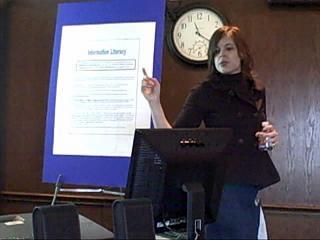
Ellie Collier leads a discussion on campus differences
We felt it was important to begin by focusing on what we know about the students we would be teaching. Our dean, Dr. Julie Todaro, presented an overview of ACC’s student population. We also watched some quick informal videos created by one of our facilitators, Melinda Townsel, asking ACC students about their own research methods and a short documentary, Private Universe, which deals with the concepts we (wrongfully) assume students already know and explains how teaching methods can create those misconceptions. Red Wassenich, our other facilitator went over some recent ACC information literacy assessment results and I led a discussion about campus differences with participants giving a summary of their campus population. For example, my campus has a higher proportion of students in English as a Second Language and developmental courses coming in to the library as well as a noticeable number of students who don’t have computers at home.
The bulk of the camp focused on cognitive development, active learning, learning theory, learning styles, and assessment. We considered having the participants break up into groups, research the topics ahead of time and present to each other. We also brainstormed people and groups we thought might be willing and able to present on these topics. This included psychology and education faculty, trainers in the college’s professional development department as well as fellow librarians at neighboring institutions. In the end, we were lucky enough to have a great number of incredibly talented librarians in the Austin area that were highly knowledgeable in the topics we wanted to cover and specifically how they apply to academic libraries. We also invited Dorothy Martinez, an ACC faculty member who teaches developmental reading and teacher training.
Which brings us to another issue: budget. We were not given an explicit budget, but were given some guidelines. For example, we were told it would be very hard to justify any food expenses, but we could provide a copy of the “textbook” to all attendees. We wanted to keep the group together through the lunch break to ensure continuity and allow for more sharing of ideas and strategies but didn’t feel comfortable asking everyone to bring their own lunch both days. We debated a number of options, including doing a pot luck or providing pizza and asking everyone to chip in $5. In the end, our generous dean personally covered the lunch expenses as well as breakfast treats for the two days. A note from the PR Facilitator: Don’t underestimate the time it will take to make lunch arrangements! Do a pre-event survey two weeks out, giving a few choices for box lunches (first day) and pizza toppings the second day. Make decisions on the aggregate results for pizzas with veggies only or some with meat. If at all possible, find vendors that deliver.
Speakers are another potential expense. Our speakers were all able to attend as part of their regular work duties, but funding would have been a consideration if we had gone with our initial learning styles idea, which included the respected but proprietary Kolb inventory ($125 for 10 surveys plus the travel cost of a trained analyst). By choosing a free learning styles inventory we were able to invite our speakers to have lunch with us and provide them with a small thank you gift (we chose travel mugs with a positive teacher message from Positive Promotions). Using local presenters provided much more than budget relief. A number of them stayed to see each other’s presentations and participate in discussion. It provided a wonderful connection between each of our institutions and inspired plans to collaborate more often.

Participants Barbara Jorge, Adrian Erb, Molly Dahlstrom, Linda Clement and Steve Self
An issue that came up later in the process was that of partial participation. We had a few librarians that were interested in attending just for one or two topics, or wanted to come to all of it, but didn’t want to give the presentation at the end. We felt strongly that a fundamental part of the camp was that it was an immersion, where participants interact and collaborate intensely. I also felt that it would send a negative message to say that those who have been here longer get special treatment and don’t have to fully participate. In promoting the training camp we had tried hard to communicate that we truly wanted a mix of ‘new to ACC’ librarians and veterans and that the presentation would be a wonderful opportunity for them to immediately practice what they had learned. We reassured the reluctant presenters that it would be a non-threatening environment with no grades or formal evaluation. Ultimately, however, everyone who expressed reservations about fully participating chose not to attend.
What’s in a Name?
One of the many important contributions of our PR Facilitator was her explanation of the importance of a name for the training – in her words “a hook to hang everything from.” We threw out tons of options and debated their relative merits. We were particularly interested in making this a collaborative and participatory endeavor that would be equally stimulating for experienced and green librarians alike. Our final choice “[RE]BOOT CAMP: Share some. Learn more. Teach Better.” set the theme of learning as a group for the rest of our promotion. Our flyer, which included our dean’s face merged with a pointing Uncle Sam, listed who had been drafted and encouraged veterans to re-enlist. One of the facilitators even wore fatigues.
Practice What You Preach
Actions speak louder than words. The fact that all of our presenters used excellent pedagogy, including starting their presentations by stating their learning objectives, speaking to different learning styles, and using active learning, solidified those strategies far more than just having been instructed on their importance. A number of participants mentioned this aspect in particular in their evaluations. Not only was the content valuable, we had role models for teaching excellence.
Since one of our focus areas was assessment, we made sure that we offered both the pre-camp survey and an opportunity for the participants to assess the camp. The Teaching Team and Staff Development Team will use those results to help structure future trainings.
Provide Recognition
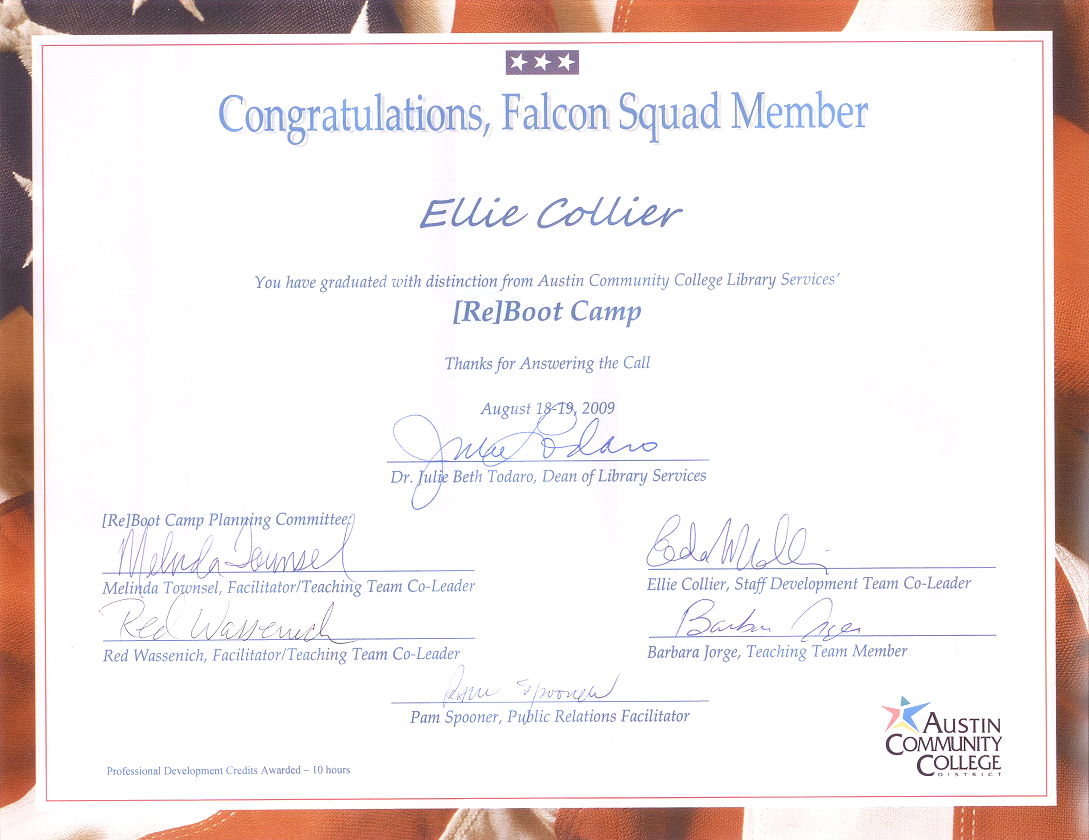
Another consideration stressed by our PR Facilitator is the importance of thanking both your presenters and your participants for their contributions and of providing a few moments to recognize each other. Each of our presenters was thanked in front of the group and given a small gift. At the end of the camp we had a very casual graduation ceremony. Each participant had his or her name called and was given a small gift (the same travel mug that the presenters were given) as well as their certificate signed by the planning team and the dean. In keeping with the boot camp theme the certificates (with a ‘Stars and Stripes’ motif in a cover with embossed gold stars) were awarded to “Eagle Squad” and “Falcon Squad” members depending on whether they had been with ACC for more or less than five years.
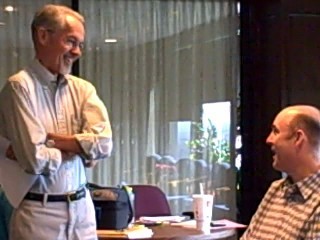
Facilitator Red Wassenich and participant Steve Self
Keeping the Momentum
It was very important for me personally to ensure that the excitement we created at camp not quickly fade away as we disbursed back to our separate campuses. On our evaluation form we asked, “What can we do within ACC Library Services to foster and maintain the ideas/tips/techniques we learned at camp?” We received excellent feedback and as a result we now have scheduled monthly discussion forums that provide an opportunity for our librarians as well as other library staff to come together to discuss procedures, best practices, tips and tricks, etc. We have brainstormed and voted on topics (not all teaching related) and I was thrilled to see our first forum, which focused on collection development, was impressively well attended. Future forum topics include presentation skills, electronic resources, and our college’s student success initiative.
Loose Ends and Final Thoughts
I’d like to close by sharing some overall suggestions and reflections.
Have a Plan B. You can’t plan for every possible curve ball, but thinking of as many as possible ahead of time, and how you might address them, can alleviate a lot of stress. We had two last minute issues come up with our location. The first, a previously unannounced fire drill set to happen about an hour into the program, ended up being rescheduled before we even decided how we would handle it. The second, the unforeseen closing of the library due to A/C maintenance, meant that we no longer had access to the computers and printers we had planned to use to have the participants fill out and score their learning styles questionnaires. This news came after we had already scheduled lunch arrangements with vendors close to our chosen location. After a minor panic, the planning team decided we could work around this by using the faculty computer center and the library laptops rather than move to a new location.
Be sympathetic. Remember to extend the same courtesy to your colleagues that you do to your students. I am forever grateful to my reference instructor for ingraining in me the cognitive, affective, and behavioral aspects of the reference interview. I happen to be very comfortable speaking in public, to large groups or small, to friends or strangers, however, the presentation aspect of the camp was a looming issue for a number of our librarians. The idea of teaching to their peers was quite unnerving to some. I failed to give that issue due respect. It might have been better to provide the librarians with the full details of the assignment earlier in the process, to listen more sympathetically to their fears, and to respond with more empathy. Another approach might be to provide a session on overcoming presentation anxiety prior to the camp, or making that topic a part of the camp.
Make time for reflective writing throughout the process. Include guiding questions such as, “How will you use this in your next instruction session?” or “Why is this important?” Some of our presenters did this, and my notes and retention from their sections are far superior to the other sections where I either chose to just listen and rely on the handouts, or scribbled furious notes which have since lost their context.
Specifically focus on getting one-shot instruction sessions right. Talk about working with faculty, especially those with no assignment or bad assignments, to create a valuable library experience. Spend time discussing how much to realistically cover in one session. Emphasize strategies for helping students get the basics. Our cognitive development section touched on this when our presenter pointed out that most of the ACRL information literacy standards are well above the developmental level of most of our entering students and it was a real eye opener.
Plan follow-up standalone workshops open to all staff. Some examples we thought of include: using LibGuides as teaching tools for individual classes, profiles of community college students, presentation skills, and scheduling video taping or observations of teaching sessions.
Your turn
Have you planned or participated in something similar at your institution? What did you do differently? How did it work out? What would you like to get out of this kind of program? Share your successes and frustrations in the comments.
[RE]Boot Camp Resources
- Schedule (.doc)
- Invitation (Google Doc)
- Pre Camp Survey (Google Form)
- Information Literacy Definitions (.doc)
- Learning Styles Inventory (website)
- Presentation Prompt (.pptx)
- Post Camp Evaluation (Google Form)
- Completion Certificate (.png)
- Textbook: Bain, Ken. What the Best College Teachers Do. Cambridge: Harvard, 2004.
Thanks to my colleague and co-planner Pam Spooner and to ItLwtLPer Hilary Davis for their feedback and edits.
Many of our participants commented on how impressed they were with the presenters, so I’d like to also give many thanks to: A.J. Johnson (University of Texas at Austin), Barbara Jorge (Austin Community College), Liane Luckman (Texas State University), Dorothy Martinez (Austin Community College), Meghan Sitar (University of Texas at Austin), and Dr. Julie Todaro (Austin Community College) and to our planning team: Barbara Jorge, Pam Spooner, Melinda Townsel and Red Wassenich.