


Sense of self: Embracing your teacher identity
Welcome to another guest post at ItLwtLP. This time we bring you thoughts from Carrie Donovan, an instruction librarian at Indiana University Bloomington. Enjoy!
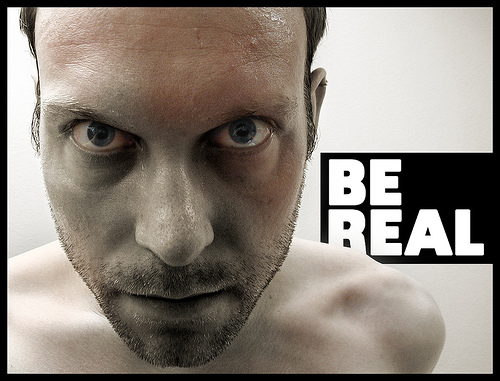
#307: Authenticity by Flickr user assbach c/o
Once upon a time in libraries, you could call yourself a good teacher if you spent more than 30 minutes planning a lesson, if you wowed students with your search savvy, or if nobody fell asleep during your presentation. With the growth of instructional initiatives and influence across libraries of all kinds, however, expectations for librarians to develop teaching expertise have heightened. Librarians who teach now find themselves faced with the demand to connect with students, to make libraries and information literacy knowledge meaningful, and to create learning opportunities that are memorable and long-lasting. Such a shift in expectations calls for teacher behavior that is purposeful, mindful, and rooted in the self. Transformation of this sort does not come easy, nor does it happen magically. For those in search of a true teacher identity, authenticity will serve as the best guide.
In order to create the dynamic and engaging environments that are becoming the norm among library instruction and information literacy programs, librarians rely on the participation and interest of their audience to co-construct learning. This type of dialogue requires an open and honest classroom environment in which the librarian is a facilitator and guide for learners as they discover the world of information. In asking students to be present and participatory, we must respond by bringing our own professional and personal wealth of knowledge and experience to the conversation. Putting away the “persona” of teacher and disclosing more of the personal will allow for meaningful interactions with students, increased student involvement, and memorable classroom experiences. From Roger Schank (1990), we learn that keeping up our end of this dialogue means introducing our experience and our emotions into teaching opportunities in surprising and story-driven ways. Based in real-world experiences, stories allow us to share with each other, while also making sense of the world around us as we interact with it. The Schankian application of storytelling to create a direct connection to students’ dynamic memory can also be useful for teachers in the quest to become more personable and approachable to students.
The Paradox of Teaching
Talking about bringing your real self into the classroom is one thing, doing it is another thing entirely. Especially when one considers the following paradox: as teachers, we employ many of the techniques of actors, but in order to be most effective, our teaching must not be artificial. For anyone who teaches regularly, it’s easy to recognize the aspects of teaching that are similar to acting: the preparation, the practice, the warming-up of vocals, the nerves, the sweaty palms, and the vulnerability that comes with setting oneself up for approval or disapproval. In addition, teachers, like actors, often summon a charm or dynamism from within, in order to exude a presence and authority over the purpose and direction of the content for their audience.
After library instruction, I’ve had students say to me, amazed, “Gosh, you really *love* the library, don’t you?” Okay, so maybe I’m a much more enthusiastic person when I teach than I am otherwise, but I’m hopeful that my teacherly self, while a slightly more dynamic version of myself, still comes from an authentic place. If I can surprise, intrigue, or engage students because I present the shiny side of myself when teaching, I’ll do it. Becoming the most special and charming version of one’s self takes some preparation, of course, one cannot just go into the classroom cold. You have to warm up, just like actors and athletes. For example, I had a ritual with my former office-mate that entailed jazz hands and dance moves as a precursor to teaching. Nowadays, my graduate assistant and I joke about putting on our “instruction face,” which usually involves eyebrows up and a big smile. The confidence and giddiness that comes with these warm-up activities can help quell the nerves and fears that sometimes haunt teachers.
Most librarians, even those of us who are devoted to teaching, will admit that many of the same challenges that actors face in terms of stage fright also plague teachers from time to time. After ten years of teaching in libraries, I almost always feel anxious and frightened prior to any type of instruction. To overcome my fear of public speaking as a novice teacher, I started using sarcasm as a coping mechanism. Sarcasm, I have discovered, does not translate well to the classroom setting and put me in complete opposition with my authentic self. Letting go of this crutch has not been easy, but it has been necessary to the successful development of my teacher identity. Without that barrier between myself and the students, teaching and learning experiences have become more open and egalitarian, so that now we share in the vulnerability and the anxiety, as well as the benefits and opportunity that come with it.
While I still rely a lot on sarcasm outside the classroom, I no longer use it to appear fearless. In fact, I think fearlessness among teachers is highly overrated. It’s the adrenaline that comes with my stage fright that is almost like a drug to me, it keeps me coming back into the classroom. Having acknowledged that it will most likely always be a part of my teacher identity, I can now use the rush and the motivational force of my fear to become better at my craft. R.W. Hanning (1984) compares the experience of stepping into the classroom (the start of the performance) to stepping over a threshold and in doing so, we must face our fears and meet the challenges that await us.
Although there are many elements of teaching that are similar to acting, that is not to say that we should seek to be entertainers. Neil Postman warns us about this in his book Teaching as a Conserving Activity (1979) as he discusses the use of multimedia and technology in the classroom. While librarians have some of the best technology tools to teach and to aid in our teaching, we can be true to our teacher identities by relying on our primary instrument, ourselves. We should never be phony or rely too much on props or personas, but instead, we should strive to find the authentic place within from which to direct our teaching. That authenticity will evolve and change depending on the topic, audience, and situation of the day. As teachers, we should be willing to accept the risky nature of this activity and embrace the tension that exists between teaching from a place of authority, while also sharing of ourselves in such an authentic way that we become vulnerable.
Becoming Authentic
OK, so, how does one do this? Can authenticity be learned? The answer is both yes and no. We’ve all had great teachers and memorable learning experiences that shape our construct of what good teaching should be and what it looks like. What makes authenticity in teaching so elusive and slippery is that we cannot simply adopt those approaches as our own and expect them to work just as well. Instead, we must know ourselves well enough to identify our own personal qualities and wisdom and allow those to shape a unique approach to teaching that is true and relevant for us, that comes from a place within us that is real.
Teacher personality has been identified by several studies as a powerful component to effective teaching, more important even than intelligence, in some cases. When associated with personality traits, Laursen (2005) measured authenticity by looking at the extent to which teachers view students as fellow human beings, whether or not the teacher hides behind a detached persona, and how often/much teachers view themselves, as well as students, with intentions, emotions, and interests that are uniquely their own.
The difficult truth that must be acknowledged is that some teachers have a charisma and, as Malcolm Gladwell labels it, withitness, that is innate; thereby giving a natural spark to their teaching. For those of us who are accustomed to expecting results from hard work and practice rather than talent or personality, good teaching is also achievable, but it may not come as easily or inherently. But for those who want to try, the rewards are immeasurable. Just watch any film about teaching to understand what I’m talking about.
In his book, The Courage to Teach, Parker Palmer (1998) discusses identity as the evolution of all the forces that come together to form a person, including: background, culture, experience, and anything else that shapes the self. Recognizing that we bring all of these aspects of ourselves to everything we do, including our instructional activities, is key to finding your teaching identity. Librarians have pursued neutrality for a long time in their provision of organized and accessible information and knowledge, but this philosophy does not serve us well in the classroom. As teachers, we must acknowledge that neutrality is unrealistic and unattainable, and by seeking it we are only doing a disservice to our learners. If we define learning as the ability to think for oneself and information literacy as the knowledge and skills to be thoughtful consumers and creators of information, then we should embrace our teaching as an opportunity to help learners recognize, understand, and question perspectives and ideologies that they encounter in information seeking.
Critical theory, as described by Powell, Cantrell, and Adams (2001), provides an excellent framework for integrating one’s teacherly identity into instruction in order to create opportunities for enhanced student learning and empowerment. Letting go of the notion that information is neutral and that we should teach information literacy or library instruction from a neutral position will allow us to provide a context to our teaching based on experience, perception, and meaning. For teaching to be memorable and meaningful, it must come from the true self and from a willingness to share the beliefs, values, and perspectives that shape it. Espousing this type of behavior in ourselves will encourage our learners to examine what shapes their identity, thereby creating opportunities for learning surrounding the questions and curiosities that arise as a result of self-disclosure, self-awareness, and self-examination.
Patricia Cranton, author of Becoming an Authentic Teacher in Higher Education (2001), presents strategies for understanding the “Self” in order to arrive at a personal and professional identity that intersects at teaching. In addition to reminding us of all the attributes that are indicators of great teachers, Cranton offers step-by-step approaches for identifying ways of discovering and disclosing your authentic self in the classroom and how to live with the benefits, as well as the fallout. Some of these steps include: understanding values and experience, merging self and teacher, telling your story, connecting with students, and knowing your critics. I like Cranton’s text as a complement to Palmer’s, as it is less inspirational and more practical. Sometimes librarians need that.
Sounds easy enough, right? To be authentic, just know yourself and be yourself! Right! However, there are many ways that this can go wrong. Students may not be accustomed to having teachers who are forthcoming with the personal aspects of themselves. They may misinterpret a teacher who is approachable as someone who is attempting to “be a friend”. Successful teaching still depends a great deal on relationship-building and students may feel annoyed or alienated by teacher self-disclosure. As with any relationship, teachers and students must seek a balance through trust-building and negotiation that allows for a teacher’s identity and authority to co-exist with students’ learning expectations and goals.
Despite the dangers and difficulties, it has been my experience that most students are open to recognizing teachers as being whole people who possess knowledge, experience, and interests that extend beyond the realm of the academy. I was pleased to see this corroborated in two studies. In 1994, Goldstein and Benassi looked at in-class participation by students and the effect of teachers’ self-disclosure on it. Upon examining students’ participation in class discussion, the number of questions asked, and the willingness to express opinions and feelings in class, the study concluded that teacher self-disclosure was positively correlated with the amount of class participation by students. Similarly, a recent study conducted by Mazer, Murphy, and Simonds (2009) looked at teacher self-disclosure in the social networking site, facebook. These researchers found that instructors who strategically share personal information (e.g. photos, interests, quotes, status, etc.) positively influenced their students’ perceptions of the teacher’s credibility, specifically competence and trustworthiness. Allowing students the opportunity to recognize similarities between themselves and their teachers, in addition to seeing teachers as people, with lives beyond the classroom, could contribute to the creation of the types of open, honest environments that encourage dialogue, participation, sharing, and ultimately – learning.
Beyond Teaching
Knowing and incorporating one’s authentic self into other areas of work can also result in great success. In leadership, librarians who stand for something and communicate their values demonstrate integrity and credibility. Robert Evans, in Educational Leadership (2007), describes the characteristics of authentic leaders as: vision, personal ethics, and belief in others. Just as when you think of great teachers you’ve had, you can probably also think of great leaders you’ve worked with who not only have a strong sense of self and inner direction, but also share it openly with those around them. This awareness and disclosure of self establishes a culture of honesty, trust, and fairness that is central to creating a common vision and shared commitment in any organization.
Down to You
Authenticity. Something that is so central to the success of one’s craft could take an entire career to cultivate, without ever truly reaching the pinnacle of achievement. But, librarians out there, if you’re anything like me, you revel in your teaching escapades because they are the one aspect of the job that is challenging beyond all expectation, shaking both body and soul, and making you all-around better and stronger. If it were easy, everybody would do it. But teaching, like so many things that are worthwhile, will break you down before it charges you up. It offers up the sweetest rewards for those who are willing to take the hardest hits. Nobody could do it really well without the reality and rawness that comes with self-disclosure, which can be at times a breathtaking walk on a tightrope and, at others, a freefalling leap of faith.
Librarians who are bold enough to develop their inner teacher will connect more deeply with learners and participate more fully in the learning process. Our authenticity will extend beyond classroom encounters to influence the teaching practices of our library colleagues and impact the instructional role of our libraries. With the potential to enhance student learning and increase the relevance of libraries to the teaching and learning continuum, authentic teachers have the opportunity to guide and lead our profession to new heights. As we pursue this path to teacherly identity, let’s be truthful, take risks, and follow our hearts. Remembering all the while, of course, that teaching is not about us, it’s about our students and their learning, as well as our libraries and their future.
If you’re a teacher who has sought out or achieved authenticity, please share your experiences, comments, failures, and successes. I look forward to hearing from you.
Recommended/Further Readings:
- Cranton, P. (2001). Becoming an authentic teacher in higher education. Malabar, FL: Krieger Publishing Co.
- Elmborg, J. (2006). Critical information literacy: Implications for instructional practice. Journal of Academic Librarianship, 32(2): 192-199.
- Evans, R. (2007). The authentic leader. In The Jossey-Bass reader on educational leadership (2nd ed.). (pp. 135-156). San Francisco: Jossey Bass.
- Gladwell, M. (2008, December 15). Most likely to succeed: How do we hire when we can’t tell who’s right for the job? The New Yorker, 36.
- Goldstein, G. & Benassi, V. (1994). The relation between teacher self-disclosure and student classroom participation. Teaching of Psychology, 21(4): 212-217.
- Hanning, R.W. (1984). The classroom as theater of self: Some observations for beginning teachers. ADE Bulletin, 077, 33-37.
- Laursen, P. (2005). The authentic teacher. In D. Beijaard, P. Meijer, G. Morine-Dershimer, & H. Tillema. (Eds.). Teacher professional development in changing conditions. (pp. 199-212). New York: Springer.
- Mazer, J., Murphy, R., & Simonds, C. (2009). The effects of teacher self-disclosure via facebook on teacher credibility. Learning, Media and Technology, 34(2): 175-183.
- Palmer, P. (1998). The courage to teach. San Francisco: Jossey-Bass.
- Postman, N. (1979). Teaching as a conserving activity. New York: Delacorte Press.
- Powell, R., Cantrell, S.C., & Adams, S. (2001). Saving Black Mountain: The promise of critical literacy in a multicultural democracy. The Reading Teacher, 54(8): 772-781.
- Schank, R. (1990). Tell me a story: A new look at real and artificial memory. New York: Scribner.
Recommended Viewing:
- Dead Poets Society
- Emperor’s Club
- Finding Forrester
- The Karate Kid
- Miracle Worker
- School of Rock
- Spellbound
I would like to thank Emily Ford for inviting me to reflect on my teaching identity in order to write this piece and for being an inspiration to radical librarians everywhere. Also, thanks to Randy Hensley, who first challenged me to tap into my authentic self at ACRL’s Immersion program in 2003 and to my friends Jennifer & April who have been my instructional support system (and cynical touchstones) ever since that time.
Special shout-out goes to all the IU-SLIS Instruction Assistants and students in S573, past and present, who make teaching and discussions surrounding teaching a pure joy (especially Rachel Slough for her endless enthusiasm and willingness to serve as my reviewer on this project).
This post is dedicated to my mom, Gloria Donovan, the most authentic teacher I’ve ever known.
Thanks for a great post, Carrie!
In reading this a few times now, I keep coming back to the question of library school education. We have to learn to be authentic, but we also have to, in library school, learn how to teach. This is something that I think can get lost in the process. These days librarians are teachers, even if we present no formal classes. But how do we learn to be such?
During graduate school I noticed when I had classes taught by graduate students (my peers, mind you) that I was frustrated by lack of teaching ability.
I wonder if you can offer some thoughts on educating librarians to be teachers?
This brings about question of what should be combined with a traditional library education. I have heard various things such as, “I firmly believe today’s library degree needs to be combined with _____” (here you can enter masters in business administration, teaching, dual masters program, IT, etc.). I have heard from teachers and faculty that not having an educational foundation in teaching is an impairment. I’m curious if a library degree can really be a stand alone degree anymore.
Heather, I appreciate your comment. If you read Malcolm Gladwell’s New Yorker article on “withitness”, I think you’ll find it relevant to our conversation. The article describes that the common element among successful teachers (or NFL quarterbacks) isn’t the training or experience they have, but it’s that certain something, that spark that really sets them apart from others in the profession. I do think having some foundational knowledge of educational theory and teaching practice that comes from coursework is important, but it’s not everything. I have a feeling we will see more opportunities for people to enter teaching (and possibly other professions?) without so many of the traditional requirements… simply because success in these fields does not always depend upon coursework alone.
Emily, I think your concern is valid and there is much in the library literature to document the disconnect between professional expectations of the workplace and the education we receive in LIS programs, especially when it comes to developing/understanding our role as teachers. I teach a course at IU’s School of Library & Information Science called “Education of Information Users” and I’ve received good feedback from students in the course regarding the usefulness of it, for their graduate studies AND in finding/succeeding at that first job. Like so many aspects of librarianship, there is nothing that compares with on-the-job training for instruction, but I do think a foundational course in pedagogy and teaching practice is essential for future librarians.
What a wonderful, uplifting post, Carrie. I’m reminded of what Jorge Luis Borges once said about paradise being some kind of library. It’s amazing how few people love to read books when the wisdom of the ages is at our fingertips. It was also a delightful surprise to see that your recommended viewing tips are actually some of my favorite movies.
Great post! You seem to be writing from an academic library perspective and I’m curious how public library instructors (for computer classes, etc.) might relate to this. Students at a university tend to be of the same age group, all working towards a similar goal of getting their degree. But the diverse patrons that take a class at the public library might have completely different goals and expectations of the teacher. I feel like a public library instructor might have a different approach to authenticity in the classroom with respect to the many ethnicities/religions/ages/etc. that come with a public library. Any instructors out there who have thoughts on this?
Great question Lindsay-
I’ve taught in both an academic setting (currently) and a public library setting, and I’ve found that my students, be they 18 year old freshmen or baby boomers all appreciate an open, honest and approachable instructor, as well as someone who can break jargony library-speak, complicated OPACs or intimidating technology down into manageable bits of information. Being able to make connections for them between something they already know to something new is helpful as well. Carrie really hit the nail on the head with this one! Excellent work!
What a timely post. With Fall semester in full swing, this is a great piece to reflect upon before the onslaught of library orientations.
In response to Emily & Heather’s thoughts on teaching and library school education, I have been teaching in libraries for seven years now, and everything I’ve learned about it has been on the job. That said, I’ve found that story telling is a great method for student engagement, as is asking and using people’s names during a class, and getting as much audience participation as possible. I get volunteers from the audience to be the ‘google jockey’ at the computer, so i can run around and point things out on the screen. Giving students a choice at the start of class is another method: what do they want to learn about the library? (remote access? how to find a journal article?) and go from there. Establishing a dialog, rather than a lecture, goes a long way in engagemed learning. (Most of the time. Sometimes you’ll just get stuck with a class full of zombies-usually it’s right after lunch.)
I have been in a K-12 school for the last 10 years as their library media specialist. The first year it seemed as all I did was keep study hall. I was ready to leave as soon as the year was over. After that things got better. I still spent my time just checking in and out books when a teacher made them get one. I am working to change that as the years go by. I was in a room no bigger than the size of half of a reagular class room but now I have a new room and some computers. I am ready to change things up. I am going back to school to learn some more technology and hope to incorporate it in with the classes as they come in. This is a slow process for we do not have the equipemnt, time or schooling to do so. I am up for any suggestions to help get this library up to the point it needs to be in this day and age.
Carrie, Awesome piece! Just in time for the start of the semester.
I am currently in library school, but many years ago I was the general chemistry lab instructor at a major university. Although I only taught for one school year I completely enjoyed the experience. I always found that being honest with the students, having a sense of humor, and being prepared made everyone’s experience more productive and pleasant. My students seemed to especially enjoy those times when I related how I had struggled with a concept, and how someone had helped me to understand it as I was helping them. Because I was willing to admit problems and mistakes I had made, when appropriate, they seemed more comfortable admitting that they too had questions.
Carrie, what a wonderful piece to start my Thursday. I can really tell how influential the Immersion Program was for you and I am only beginning to realize how important and inspiring it was for me as well. One thing that I really took away from your reflection as well as from Randy’s many lessons at Immersion, was that if I practice authenticity in my daily life, it will become much easier to be authentic in the classroom. This is no easy task but it is something I am trying to practice each day and only time will tell how my role as a teacher will be affected.
Thanks so much for sharing this.
Thanks to you, Julie!
I’ve seen Carrie teach and she’s as inspiring in person as in her article. Authenticity is such an interesting topic, in and out of the classroom!
Thank you, Carrie! I’ve struggled with the concept of being an “authentic teacher” since Randy Hensley introduced it at Immersion ’08. Your post has helped me “get it” better and feel more connected to the concept. I’ll be working on my authentic teacherly-self.
Now, if only I had a natural “shiny withitness!”
I agree with you, Shana. It is a struggle. Parker Palmer discusses the evolution of “self” and how important it is to be tuned-in enough to recognize the changes in you and your audience over time. Looking at things this way, it makes “self” seem even more elusive. Although, I do find it very calming to know that even a veteran teacher struggles with identity and that for PP, as well as the rest of us, authenticity seems to be always just beyond our reach.
I recently took a “Literacy and Learning” course from James Elmborg at the University of Iowa, and I agree that the relationship between teacher and student is so important for meaningful learning to take place. Isn’t teaching ultimately about a self-actualized person who helps others on their quest to become self-actualized, too? For me, this all ties into being “thoughtful consumers and creators of information,” as you so eloquently put it!
After reading your post, I’ve been thinking about my role as a library school *student*. The librarians who are teaching me are doing their best to present the “shiny side” of themselves, to be the “most special and charming version” of themselves — shouldn’t I offer them the same in return? I’ve realized that, as a student, I can often come across as defensive or argumentative. But your post has reminded me that my persona also affects the learning environment. From now on, I will be trying to show the “shiny side” of my student self!
i work for an organization that has often cited itself as “amongst the world’s greatest” – The NYPL – The New York Public Library. they may once have adopted the nickname “the poor man’s university” to be politically correct & more accurate it really should have always been known as “the working man’s university” or now more accurately “the non-working man’s university”. i have worked here for 18 years mainly as YA librarian and i have always considered myself a teaching librarian.
in the last 8 years nypl has departed much from it’s ideals. since september of 2001 a hiring freeze was declared. even though the city and the nypl administration had experienced mainly good financial times during these years.
now instead of 7 or more librarian at a branch level 5 has been the quota but attrition has also been the rule so that many branchs now must function with only 3-4 librarians.
nypl has increased the amount of computers with internet access as well as the amount of its dvd collection. they have weeded print collections including reference collections all this while reducing the amount of librarians, clerks, pages & other staff.
something is wrong here. there is no one to teach or guide patrons because every one has expanded work loads even the free computer classes they offer have been scaled back.
i now dream of retirement while back in 2001 i had look forward to 15 years more at nypl.
This is so inspiring! I agree that exposing the authentic self can improve teaching and learning, but I’ve never really thought about it in this way. Thank you for expressing it so well. A couple of things I struggle with are 1) striking the right balance between teacher and “friend”, as you mentioned and 2) trying to accomplish making connections with students in a one-shot session.
I’m happy to see Karate Kid on your viewing list – such a good example of scaffolding theory!
Pingback : T.S. Eliot was dead wrong « lyndamk
Pingback : Wonderful world of blogs … « Market Intelligence for Librarians
Pingback : Sense of Self: Embracing your teacher identity « Amber Welch