
Outreach is (un)Dead.

Photo by Flickr user laura padgett c/o
By Emily Ford
Outreach is dead. It’s time we put its body in a coffin, say our collective prayers and move on.
You see, for most of the summer I undertook a long series of “outreach” trips to promote and educate the public at large about a grant-funded project I’d been working on for the past year. I drove all over the state of Oregon, to the desert in the East, the rolling mountains in the South, up and down the rocky coast, and through the farm and ranch land in Western and Central Oregon. During these long trips (imagine expanses of high desert for 200 miles before you hit a rest stop or gas station) I had a lingering feeling that what I was doing was definitely NOT outreach. Instead, I was promoting and marketing a service and tool that, for the past year, I had been helping to build at my place of employ.
What IS outreach in libraries today? It became my mission to discover a succinct working definition of what we do that so many of us consider outreach, yet my conclusion remained embedded in that same violent phrase: outreach is dead. When this thought first occurred to me my brain immediately began singing the lyrics to Bauhaus’s hit Goth Rock song Bela Lugosi’s Dead. (“…Bela Lugosi’s dead/ undead undead undead/Oh, Bela/Bela’s undead…)
We need to lay rest to outreach’s physical body–that separate entity that comprises library departments and ancillary programs. As well we need to lay to rest the word “outreach,” whose separate existence inhibits and deters us from doing what we as libraries, librarians, and information professionals should be doing. Instead of integrating library promotion, advocacy, and community-specific targeted services, we have left “outreach” outside of the inclusive library whole to be an afterthought, a department more likely to get cut, or work function of only a few, such as your subject librarians. If we kill this notion, if we consider the word and the separate entity of outreach as dead, we are more likely to be able to embrace and participate in activities formerly known as outreach and incorporate this essential part of our jobs into our daily work routine.
Definitions
Before I came to the conclusion that outreach is dead, I attempted to re-define outreach as such: Outreach is marketing. If the people who you’re attempting to reach seek services from you (rather than you reaching them) it is not outreach. The agenda behind library outreach should be to offer services without monetary gain, and to identify and fill service voids for people who are not looking for them. Unsatisfied with my definition I asked my dad. His response was “I let the NSF [National Science Foundation] define that for me.” (My dad is an organic chemistry professor.) I was not convinced that a funding agency should have the ultimate say in what “outreach” activities should be or include; particularly in libraries. It was then that I decided to turn to my colleagues and professional literature to seek a good definition.
Scott Pointon (Public Libraries, 2009) refers to the following definition: “Draw a circle around the central or main library building–every library service, program, or library-related endeavor taking place outside that circle is outreach.” (5-6). Likewise, in her introduction to the Extraordinary Outreach section of Public Libraries last winter, Nann Hilyard points to the Random House Webster’s College Dictionary definition of outreach, “noun: the act of extending community services to a wider section of the population. Transitive Verb: to reach beyond, exceed” (20). Unsatisfied with both of these definitions I turned to the Oxford English Dictionary (OED) online (thanks, Multnomah County Library, for my remote access to this!) I found:
Outreach. Noun. b. spec. The activity of an organization in making contact and fostering relations with people unconnected with it, esp. for the purpose of support or education and for increasing awareness of the organization’s aims or message; the fact or extent of this activity.
None of these definitions are satisfactory to me. And none of us define outreach in the same way. Pointon’s definition is great, but it pulls into play the struggle libraries are having with “library as place,” an issue recently addressed in The Journal of Academic Librarianship by Sennyey et al., 2009. Current library services transcend the physical boundaries of a library building. Many collections and services offered by public and academic libraries are used remotely. Users access library services from home, in their offices, and even via mobile devices. “…the bond between users and the physical library will change and if poorly managed the “library as place” will become just another campus building” (Sennyey, et al., 2009). In this way, defining outreach by physical boundaries (a body) does not reflect the wealth of services that libraries provide and undermine our community-centered work.
The OED definition is great, but to me this definition gets back to my first instinct: this is marketing, not outreach. In fact, I looked at the OED definition of marketing, and felt that the two, for our intent, are almost interchangeable.
Marketing b. The action or business of bringing or sending a product or commodity to market; (now chiefly, Business) the action, business, or process of promoting and selling a product, etc., including market research, advertising, and distribution.
Our product is our service. To many librarians marketing can be a dirty word and outreach almost saintly. But in so many articles about outreach authors seem to refer to library service promotion as marketing anyway. (see Dawn Bussey’s Getting the Word Out, Eugene Jeffers’s Electronic Outreach and Our Internet Patrons, and Rebecca Donnelly’s The Misguided Relationship.) I think we should embrace marketing for what it is, and let outreach diffuse into our daily routine. Moreover, the first use of the word outreach in this way was over 100 years ago, in 1899 according to the OED. Since libraries have changed so much over the past 100 years isn’t it time we find a new way to express and incorporate community-centered work? The OED definition reminds me of a picture I snapped while on my outreach excursions.
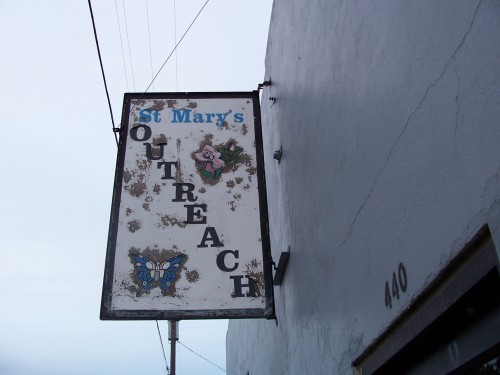
The Sign to St. Mary’s Outreach in Pendleton, OR.
The paint is peeling. Obviously its current physical manifestation could use some help. Likewise, when we use the term “outreach” we typically refer to an older and more traditional notion of what the word means. For us to move beyond this idea, we just might have to start using different words and detach current assumptions about “outreach” to discuss our “outreach” activities.
Differences Between Academic and Public Libraries
In academic libraries outreach seems to mean one of a few things. First, you have to reach your constituents. Some libraries have a Facebook page and some libraries tweet. You might also provide orientations to new student cohorts or you might offer satellite library services in a different building such as a dorm or a student center. Other examples could be creating relationships with faculty to provide services that support teaching as well as to their students to support course-specific learning. These examples seem to encompass much of what academic “outreach” focused activities include. To me, all of these services should not be contained within a separate body, department, or undertaken by just the “Outreach Librarian.” Instead, they are part in parcel what we do. As professionals we should all be talking about the library in our communities and fostering relationships. We should be offering satellite services and, yes, we should all have down pat our 30 second “why the library is important” elevator speech. These are essential aspects of a library and of any librarian’s job. They are not separate nor should they be contained in a different or a sole unit or entity.
Unlike academic libraries, Public library outreach programs seem much more identified by space and place. Bookmobile services, library services provided to those in jail, services at senior centers and in schools are all examples of what would fall under the “outreach” umbrella. Dawn Bussey discusses the various things that the Glen Ellyn Public Library has done in their community and outside the library’s walls (Public Libraries, 2009). But let’s face it, these services and the community-based nature of public libraries are essential to what today’s library is. It is not extra, it is mandatory and we should all be engaged and providing targeted, community-based services to our constituents.
Community Engagement and Marketing are Essential
The nature of libraries has changed enormously. The physical building is less important. Books are less important. Due to these changes libraries will become obsolete in today’s current market where information needs are created and fulfilled by (my favorite “frenemies”) Google and Facebook. People purchase books from Amazon, they read blogs, wikis and other online commercial (and non-commercial) information sources. But libraries have what they don’t and we need to let our users know this. We have the ability to be in our communities, to engage them and offer specific targeted services. Our engagement with our communities can be the defining aspect of what a library is to any given community—and that sounds a whole lot like what one “outreach librarian” was doing or one “outreach department” does in the old “outreach” paradigm. I am not trying to undermine the importance of marketing, advocacy, or library services. Traditional “outreach” services should be an integrated part of what we do, not an aside, a tacked on item.
Problems We Face in Death
Just because libraries need to change and have changed does not mean that the politics of our respective institutions and governing bodies have. Many institutions, such as my own, have “outreach” outlined in their missions. Institutions might use “outreach” to exemplify their worth for grant or other funding sources, which frequently require “outreach” activities be incorporated into funded projects. (Much like my dad’s example and my recent travel around the state of Oregon.) We need for our city governments and our library and university administrations to advocate for libraries and library services in the manner I have described. When crucial administrative decisions get made, for example to open a new campus, build a new building, or to add a new degree program at a college or university, libraries and their services need to be represented. If we have successfully advocated for our constituents by providing them with quality targeted, community-centered services, they will advocate for us. In the end, we might be able to provide those essential library services without being restricted by traditional “outreach” departments or initiatives.
Another issue facing libraries and library staff is training. How are we going to train library staff to provide those 30 second elevator speeches? Who will take the lead to ensure that circulation staff, reference staff, and others know how to engage in the services we’ve been calling outreach? If we expect everyone to engage in this work, staff need to have the skills and knowledge to be able to do so.
Finally, outreach is usually considered a separate department, when marketing and promotion of outreach activities within institutions get delegated to separate “marketing,” “communications,” or “public relations” departments. Wouldn’t it be best if the two were integrated? These departments often produce and distribute printed and written materials such as press releases, brochures and flyers, or craft an organizational mission statement. This kind of community engagement remains essential. We must learn to embrace marketing and collaborate with our marketing and communications departments for our community-centered services to achieve their potential.
The Undead
Kill your notion of outreach. We should demolish the body of outreach, but keep outreach activities alive. We should disallow outreach a separate body, but fold its spirit into our daily work and activities, for it is this spirit of work that is the very kernel of what makes a library. Let’s use different words to talk about what we do. (Please, if you have a suggestion on a new term to replace “outreach” leave a comment!) Let’s work to engage our administrators and our institutions in changing the attitude and political structure surrounding “outreach.” Let’s bridge the divide by collaborating with community and institutional partners to create and promote services. Let’s make sure library staff has the training to be able to give an elevator speech about why the library is important to community. Finally, let’s reshape our attitude and view community-based library services as essential; as the core of what keeps libraries strong and relevant to our communities.
Thanks to Gail Kouame for providing her thoughtful feedback to this post. Also thanks to Lead Pipe Colleagues Derik Badman, Ellie Collier, and Hilary Davis for their edits and feedback. Additionally, thanks to my office-mate, Andrew Hamilton, who is a great springboard for ideas.
References and Further Reading
Adams, T. M., & Sean Evans, R. (2004). Educating the educators: Outreach to the college of education distance faculty and native american students. Journal of Library Administration, 41(1), 3-18.
Aguilar, P., & Keating, K. (2009). Satellite outreach services program to under-represented students: Being in their space, not on MySpace. The Reference Librarian, 50(1), 14-28.
Bussey, D. (2009). Getting the word out. Public Libraries, 48(1), 20-21.
Connell, R. S. (2009). Academic libraries, Facebook and MySpace, and student outreach: A survey of student opinion. Portal: Libraries & the Academy, 9(1), 25-36.
Donnelly, R. (2009). The misguided relationship: Learning from outreach experiences. Public Libraries, 48(1), 24-25.
Hilyard, N. B. (2009). Cultivating support for library advocacy. Public Libraries, 48(3), 16-19.
Jeffers, E. J. (2009). Electronic outreach and our internet patrons. Public Libraries, 48(1), 21-23.
Pointon, S. E. (2009). Library outreach is the future! Public Libraries, 48(2), 2-5, 24.
Sennyey, P., Ross, L., & Mills, C. (2009). Exploring the future of academic libraries: A definitional approach. The Journal of Academic Librarianship, 35(3), 252-259.
I love being able to start my day with Bauhaus.
Emily, thank you for making a very vital point: Library outreach does not translate into library use. While pious phrases about library “communities” and “missions” sound helpful, none of it furthers the method of drawing said community to said library for it to be used. The proactive and assertive practices of marketing are much more successful at that sort of thing. It’s time to set aside librarian revulsion of the M-word unless libraries want to become more marginalized than before.
Another observation: the “outreach” attitude and approach– at least in my experience of it– implies that there is some sort of disconnect between a library and its patrons. Worse, it doesn’t leave an option open for patrons to give feedback. That hardly goes towards fostering any kind of workable community.
Outreach is only part of the process of marketing– it gets information about libraries out, and it stakes a claim for libraries in the community. But if that library community is going to thrive, libraries can’t just stop at outreach.
You could call it Community Engagement. A public library needs to reach the level of community or individual engagement. When we do outreach, we just say, “Hey lookie here, we have books and computers.” That’s not an individual message.
I like the example between academic and public libraries in the engagement process. Academic libraries have a bit more of a captive audience (you know where the students are), libraries often don’t know where their patrons are (without being engaged or using GIS). I know when I have done outreach to specific demographics, I search for the leaders of the community and work my way down on an individual level. It’s one of the few ways to demonstrate that you are paying attention and creating action based on that feedback.
I like the term “Community Engagement,” Jeff. I think this really captures what we should be doing. Also, out of community engagement comes more ideas and ideas for services that better serves the needs of our users.
I agree with you that looking for community leaders is a key way to find just where users are and start a dialogue about what users need and want from us.
How about Equity of Access? Check out Outreach as Equity… The preface talks a lot about rethinking our ideas of outreach. Very interesting stuff.
— Kathleen Houlihan, Youth Outreach Librarian…Austin, TX
Thanks for the suggestion, Kathleen, I have requested this through my library!
I meant, From Outreach to Equity…sorry for the mangled title!
My initial reaction to this post was immediately defensive, being that I am an Outreach Librarian in an academic library and I want to keep my job. But once I calmed down and read your post, you make some very valid points. My biggest issue is that Outreach positions in academic libraries have seen a tremendous increase in recent years (my own position is brand-new) and yet, there are no professional standards or guidelines for those positions. Your point that everyone defines outreach differently is very true. People always ask me “So, what do you actually do?” and honestly, there is no simple answer to that question. The job descriptions are notoriously fuzzy and it is up to each institution to define them. But because “outreach” is a great buzz word and academic administrators seem to love it, I don’t think that we will see a decrease in these positions. I completely agree that outreach, marketing and promotion are all sides of the same coin and should be a part of what every librarian and library staffer take part in on a daily basis. But what you suggest – essentially a cultural change in which everyone buys in to the need for marketing, promotion and outreach and takes at least partial responsibility for it – is, if not impossible, certainly going to take some time. So in the meantime, having designated individuals or departments to coordinate these efforts is still a necessity. I think that ultimately, that is what outreach librarians should do: be the coordinators of outreach, marketing and promotion and not the sole participants in the efforts. If anyone is interested in collaborating and working on some standards or a better working definition for academic library outreach positions, let me know. I’d be into it.
Sarah, thank you so much for posting a comment! I think you are right. What I’m thinking here is definitely a culture shift. And not only is that shift needed in libraries, but also at the academic institutional level, and the city or county level (depending on the kind of institution we’re speaking of). I would hope to be able to engage administrators and show them that “outreach” does not capture what we should be doing because what we should be doing is so much more.
I really like your idea of having a designated individual in a library to coordinate community engagement services or other activities that we would typically consider “outreach.” I think this might be a first step. The people in these positions might also become the champions for the redefinition of our work into different words and leading the way with cultural change. This person could also be the one to help train library staff for their elevator speeches, etc. I’m going to look into this at my place of employ.
As one of the reviewers for this particular post, Emily already knows that I am completely with her on the importance of having “outreach” integrated into everyone’s responsibilities, but not completely sold on the need for a vocabulary switch. To me outreach means reaching out – which incorporates finding out what people want, while advertising or marketing (though still incredibly important) implies much less user input.
I can get behind the reasoning behind terms like community engagement and equity of access, but my knee jerk reaction to them is that they feel corporate and PR spun while outreach feels straight forwards and utilitarian.
I am also probably biased in not having encountered much of the type of segregation at mpow that Emily describes. I can think of 1 or 2 exceptions (in technical services), but basically all of our approximately 25 librarians have the same job description – we all do reference, collection development/management (including department/faculty liaison responsibilities), classroom instruction, design/create study guides and tutorials, and are heavily encouraged to serve on campus-wide committees. We have a PR facilitator that we can go to for help with phrasing, tactics, etc, but honestly I think we could use an outreach coordinator like Sarah discusses to make sure that we cover all our bases and who could dedicate more of her time specifically to determining user needs and coordinating larger initiatives. For example – every semester Student Life does a big welcome to campus event at each of our 7 campuses. Typically a librarian from each campus will decide to participate and come up with something, but a focused and coordinated effort would probably have more impressive results.
But no matter what we call it and whether or not we have someone in a titled position coordinating our efforts, I completely agree that it shouldn’t be left to one person or department, rather “we should all be engaged and providing targeted, community-based services to our constituents.”
I work for a library network, and part of what we do is provide funding for outreach projects. We’ve generally defined outreach as the extension of library service beyond the library’s defined patron base (we’re talking academic and special libraries here, mostly). Feedback from some of our potential fundees has been that it’s enough of a challenge to get the defined patron base to understand the value of the library, so who has time for outreach? Now we talk about “outreach” and “inreach,” but both are really community engagement, and both are really marketing.
My favorite line from your post is this:
“If we have successfully advocated for our constituents by providing them with quality targeted, community-centered services, they will advocate for us.”
Outreach, community engagement, marketing, advocacy… maybe the differences are more than semantic because there’s a logical chronological order.
You must be in an alternate universe. The only reason our librarians are thought worthy of existence is to do Outreach. All else is worthless.
Can you tell me more? I thought my point was clear, that we ALL should be doing what we traditionally call “outreach” but I don’t think the term fits anymore. We cannot afford to corner this work and have it be the work of a few select people. In fact, it is what our worth IS. I think we agree, but I’d like to hear more about what we do that is considered “worthless.”
@Alison: I think that’s what the author was getting at– marketing begins with outreach, but outreach alone is not necessarily effective. It’s not enough to inform people of what libraries can do; we have to make it easy for them to give back to us, to use our resources, to advocate for us.
I worry that libraries fall short on outreach programs because of their dread of The M Word. They’re happy to make Twitter feeds and Facebook pages, and then don’t do anything with drawing the public to them, or making them interactive, or useful. Listening to what patrons want is all fine and good. But marketing– opening up a dialogue with patrons– a dialogue that means that the library is going to consider what the patrons want, and deliver results because they know it’s crucial to their survival– that’s taking it further. It’s necessary, and it isn’t evil.
That said, I think this is getting into a semantic roundabout, where nothing gets done. This doesn’t have to be a controversy, though I appreciate how Emily Ford has used a provocative article like this to get people to talk.
Point of fact: We need to listen to patrons, we need to give them what they want, and we need to invite and encourage their interaction, because interaction translates to advocacy. I don’t think anyone will argue with that.
Jennifer, I agree with you about the fear of the “m” word. In my experience, people are interested in trying new things, initiating new services, etc. but fall completely short when it come to promoting said services, which usually then die a slow death because no one is aware of their existence. Trouble is, marketing library services is a full-time job, and is probably the thing that falls by the wayside when people get busy with the other aspects of their jobs. It takes effort, creativity, and most importantly, persistence – you don’t just do it once and finish. It is ongoing. It is daunting and often discouraging. So with that ringing endorsement, how do we convince people it is indeed worthy of their time and that it will pay off down the road?
Sarah, I wonder if this is because some of the things people try have– gulp– no marketable value. I mean, I love Facebook pages, but if a college library with a Facebook page doesn’t reach out to students by requesting to friend them…well, all that hard work will be wasted. No one will look at that page.
On the other hand, a library that posts its Twitter feed on its website as a way of easily notifying its public of things like severe weather closures, holidays, and upcoming events can easily see the value of such a venture.
Part of marketing is figuring out whether a certain venture is worth the library’s time, staff, and money to undertake.
You know, I couldn’t agree more. Trouble is, if you don’t even give something a fighting chance to succeed in a pilot, then how will you ever know? And unless some sort of organized effort is put in to deciding what to market and to whom, then everything is more or less destined to fail at some point, if not immediately.
Sarah, thank you for your thought-provoking article. Two quotes that helped me realize that library outreach is not just having a table with booklists at the local “5 de Mayo” celebration:
Outreach = (social services) “Provision of services to those unable to seek them.” (Webster’s Encyclopedic Dictionary of the English Language, 1989)
“In order to meet the changing and growing needs of our communities, it is becoming a basic service to reach out beyond our walls and make library services not only accessible but also relevant… This means service that goes beyond the traditional realm of what we have offered in the past, and far beyond the clientele to whom we have offered it.” Marcia Trotta, Managing Library Outreach Programs: A How-to-do-it manual for librarians (New York: Neal-Schuman Publishers, 1993).
Hi – I’m a patron who thinks a lot about
public library advocacy. One thing that
is desperately needed, I believe, is an
organized national campaign to save and
nurture our public libraries. This would
be in addition to the personalized, community
outreach that libraries do in their local
communities. There are so many people
doing good things throughout the country
and I dream of collaborating around our
shared purpose rather than working extraordinarily
hard at strictly local levels.
By combining our voices, we’d have
a better chance of focusing the public’s
attention on the national treasure that
is our public library system. By actively
curating a centralized advocacy center,
we could provide high quality resources
to library friends and staff, and information
to the public and the media. Through
this center, we could facilitate a vibrant
exchange among these various constituencies,
to expand upon the dialogue (for example)
among librarian bloggers and citizens
responding to stories from prominent
news outlets (see the recent
Boston Globe article with 465 responses).
I believe there is pent-up public demand
for civil discourse, trusted information
and re-affirmation of values such as
community, personal dignity and appreciation
for diversity, respect for privacy and
intellectual freedom. I know of no better
institution to meet these needs than
public libraries. Folks just need a
reminder that they’re out there …
and that support goes both ways; libraries
need it in order to provide it.
I have a proof-of-concept developed
for a campaign and resource center and
am seeking contributors. Please contact
me if you’re interested — I’d
love to hear your ideas and share mine.
Jean
Pingback : » what is outreach? moviebuffkt
UMass started a University Without Walls in the ’70s. Your article made me remember that, and wonder if we could use a similar reference, maybe not as a defining phrase to replace Outreach, but at least as a phrase we could use on our web page to direct users to a variety of services “Beyond our Walls”.
Pingback : Connecting Librarian » Blog Archive » The M word in focus
There is so much going on in this post and its comments that I’ve been thinking hard about how to respond to all of it. Sorry that’s made me late to the party.
First, I notice several people referring to “marketing” as “the M word” so I feel compelled to point out that I contribute to a library marketing blog called “The M Word.” (http://themwordblog.blogspot.com/) My blog partner Nancy Dowd and I are fighting to make “marketing” less of a dirty word to librarians!
Second, some of these thoughts do relate to semantics, but they are important ones. Most librarians do not know the difference between these words, which is why I always start my conference sessions and workshops by defining them. Briefly, MARKETING is the top-tier activity; everything else you’re talking about falls under that. Advocacy, outreach, promotion, advertising, are all part of MARKETING.
As to know how and why to do all of these activities and make them work: this points out the need for every library to have a unified marketing plan (which should fall under its strategic plan). And, in my dreamworld, every library system would have a full-time position that coordinates all of this. Technically, that position should have “marketing” in the title, since all related activities (inc “outreach”) fall under that umbrella term.
Yes, what is necessary to make all of this work is a major shift in thinking and in organizational culture. I’ve been waiting a decade to see this happen and I’m still disappointed. All talk, little action.
I agree w/ what Jennifer Parsons says. She gets it. Her back & forth w/ Sarah hits on important points. What I think they are missing (most libs are missing) is actually understanding, and IMPLEMENTING, the set steps of what I call True Marketing. (see explanatory chart on my website: http://www.librariesareessential.com/library-marketing-resources/cycle-of-true-marketing/)
People in libraries do bits & pieces of marketing, then wonder why their efforts fail. Tired of watching this happen, I poured all of my knowledge from editing the Marketing Library Serivces newsletter for 15 years into a book. It came out in July, and it’s called The Accidental Library Marketer. It answers many of the questions that are being discussed in this post.
One other thought: yes, outreach, promotion, elevator speeches, etc should all be part of every librarian’s responsibility. BUT that requires training and practice. One reason that outreach itself is insuffient is that it has only people in those positions only reaching outside library walls. Library schools have not prepared staffers to do any sort of outreach or marketing. (Another reason I wrote the book.) So people in these positions need to also view fellow staffers as target audiences for their messages.
So my main thought on Emily’s orginal premise is this: I don’t think we need to kill outreach positions; they should be part of marketing positions. I don’t feel that killing the word will help make the activity part of everyone’s work. I think that librarians desperately need to be trained to reach out, to promote their work, and to shout about their own professional value. But there does need to be a position that coordinates all of this — just asking everyone to do “outreach” w/o direction and coordination leads to what we have now — lots of enthusiasm, very little serious success, and almost no way to measure (and therefore prove) that success and value.
It gets depressing when you really think about it, doesn’t it? We have a very long way to go.
I didn’t mention this in my earlier response, but I’ve been thinking about this a lot (particularly as my department has instructed me to come up with a new title without the word “outreach”). Some of the things I do certainly fall under marketing (which I took in grad school…thank goodness!), but many of my other duties have to do with providing access to library services & materials to those who can’t come into a library — the incarcerated for example, or children in childcare centers with working parents. This is a separate definition of “outreach”… but I’ll admit I’m at a loss as far as what else to call myself if I’m not an “outreach librarian”… what else encompasses everything I do? Access librarian sounds so… unappealing.
I really love the marketing plan. I wonder how common this is in libraries? It seems so “business-y” I wonder if it’s adopted much. Do you have a sense, Kathy, of how common these plans are?
I think also in previous comments someone mentioned the need for a coordinator for marketing and outreach type activities and I couldn’t agree more. The problem might be making the argument for boards/institutions to fund such a thing for the library…
Thank-you! I am an Outreach Intern at a large church. I have argued, unsuccessfully that outreach is not an activity for one group of people but is an important function of the institution and all who represent it. I’ve also been trying to banish the word “Outreach” and call it “Community Ministry”. When someone complained that this doesn’t describe Outreach because “lots of different groups in the church do this” it made me chuckle.
I love your examples to explain “what is Outreach” and will credit your comments to your site.
Blessings!
Victoria
Thanks so much for your comment, Victoria. I think you’ve shown that this topic is not just isolated to the professional library world.
I agree with you that incorporating the word “community” into a definition or term to describe what we do makes more sense– and does contribute to the point, that we all need to be involved.