

Sticking it to Instruction
Made to Stick: Why Some Ideas Survive and Others Die by Chip Heath & Dan Heath
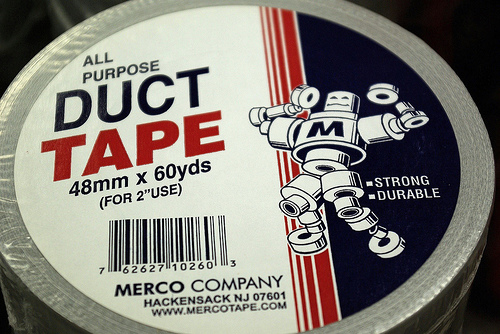
Photo by Flickr user houseofsims c/o
I always feel the need to preface my praise for this book with a little background. I’ve read a slew of best sellers on behavior. I started when a friend was raving about Malcolm Gladwell. I picked up Blink and The Tipping Point and read through them to join in the discussion. I was generally entertained but not particularly blown away. Then I read Predictably Irrational in preparation for a panel with Dr. Ariely at ALA last year. The reviews compared it to Freakonomics, so I read that one too. Figuring I was on a roll, I ran into Sway and added it to my list. They were all quick, easy, and entertaining reads. But Made to Stick was the first to truly inspire me. I had to stop every couple of pages and share a passage with someone or make a note to myself about how I could apply a concept to my work. I’m not claiming that Made to Stick is full of revolutionary ideas. It’s not. It’s also not a librarianship book. It’s not even a teaching book. It’s a marketing book, and yet page after page I found ideas to apply in my information literacy classes and to other areas of librarianship. What Made to Stick does have are excellent examples across various disciplines. (It also has a nice sized font and a conversational tone that make for easy gym reading.)
I would like to share some of the insights that stuck with me, and, in the process, encourage you to read outside your typical areas and think of how you can apply what you learn to your work. Right now, in my personal practice, I’m focusing on my teaching and how to make my one shot presentations more effective, both with my students in the library and at conferences. The examples that dealt with teaching and the possible applications that struck me while reading are the ones that stuck with me, but there’s so much more to mine here, especially in terms of management and marketing.
The Heaths “wrote this book to help you make your ideas stick. By ‘stick,’ we mean that your ideas are understood and remembered, and have a lasting impact – they change your audience’s opinions or behavior.” With that in mind they organized the book (and titled the chapters) around 6 major qualities of sticky ideas:
- Simplicity
- Unexpectedness
- Concreteness
- Credibility
- Emotions
- Stories
Again, none of this is revolutionary, but the examples (concreteness) and the Idea Clinics (sidebar thought exercises) in each chapter bring home the points. The acronym of SUCCESs was a little cheesy for my taste, but as one of my reviewers pointed out, librarians love acronyms and people remember mnemonics. So if it helps you, use it.
Simple
In the chapter on “Simple” there is an excellent detailed explanation of military strategy and the importance of the Commander’s Intent. The Commander’s Intent is the one line summary of the main objective, written at the top of the document that spells out the full strategy. There follows a detailed plan for how to achieve this, but there’s also a saying, “No plan survives contact with the enemy.” The message here is to find the core of the idea. The corollary is, “No lesson plan survives contact with teenagers,” something that I can relate to in my instruction. In fact, the majority of my sessions to coworkers begin with my asking them what they hope to get out of the class. I then sketch out the details of the lesson plan on-the-fly based on their answers. I have my Commander’s Intent in the form of the topic of the session, but am free to rearrange the actual class time based on the learners’ needs. I am still working on how to pull this method into my one shot classes, where the students are much less likely to be there of their own volition and therefore less likely to have personal objectives for the class.
Made to Stick stresses that making an idea simple is “about elegance and prioritization, not dumbing down.” I’ve been struggling to determine how much information to cover in my one shot sessions. My main objective that I repeat throughout my presentation is, “I don’t expect you to remember how to do all of this. I want you to remember that the librarians know it and you can always come to us with questions.” Likewise when I cover evaluating web sites, I’ve cut it down to “Ask yourself ‘Who wrote this?'” Yes, there’s much more to it, but not much more that can be covered and absorbed in such a short period of time. “People are tempted to tell you everything, with perfect accuracy, right up front, when they should be giving you just enough info to be useful, then a little more, then a little more.” I think so many of us struggle against this Curse of Knowledge – having difficulty seeing what we’re trying to teach through the eyes of someone who doesn’t already know it. “As a result, we become lousy communicators.” Working to make our ideas simple is probably the most challenging idea covered in the book, but certainly worth the effort.
Unexpected
The Nordstrom’s customer service training teams use a list of unexpected examples to drive home the importance of outstanding customer service. Some stories of outstanding “Nordies” include the salesperson who warmed the customer’s car while he finished shopping, the one who ironed a customer’s shirt so he could wear it later that day and the one who refunded a set of tire chains – even though Nordstrom’s doesn’t sell tire chains. Telling people something unexpected shakes them out of their standard assumptions. Most people would presume to know what good customer service is, but the unexpected story of warming a customer’s car causes them to reevaluate the meaning of outstanding.
This brings up another common problem in my classes: battling over-confidence. If my students assume they already know everything they need to know about doing research, why would they want to listen to me? Both Made to Stick and one of my colleagues have suggested the same solution: engage people by having them vote publicly and commit to an answer. Made to Stick tells of a study of 5th and 6th graders who were assigned to interact on a topic. They were broken into two groups. One group’s conversation was lead to foster disagreement, the other group’s conversation was steered towards consensus. The group whose discussion had more disagreements was more likely to skip recess to watch a video on the topic. They were more engaged than the group that quickly came to consensus. As I reviewed this section I was reminded of a recent discussion over iClickers. One of my coworkers said that she has the students vote on whether a particular site is appropriate for college level research. After they vote she has them find someone with the opposite point of view and try to persuade them. She has them vote again after their discussion and finds that the majority have come around the the right conclusion.
Concrete
“World class customer service” is abstract. A Nordie ironing a customer’s shirt is concrete. Simple and unexpected are hard and take effort. Being concrete just takes remembering to do it and not slipping into the Curse of Knowledge. There are a number of great uses of concreteness in terms of marketing in this section. In one example the people behind Hamburger Helper took the abstract idea of their users and nonusers and made them into concrete detailed pictures of individuals. The Hamburger Helper product team had multiple binders full of data on their customers, so much that it was overwhelming. They put the binders aside and sent small groups into homes where they saw that mothers valued predictability in flavor and convenience to make. Seeing the mother searching for her child’s old familiar flavor on the shelf amongst a slew of new alternatives and then preparing dinner with a child on her hip made the idea of convenience concrete. Hamburger Helper ended up simplifying the product line and, subsquently, increasing sales. Creating a concrete, detailed description of your library’s users sounds like an excellent exercise for an all staff day or, even better, an outcome of a full blown user study. At my community college we would likely create three: the transitioning-to-a-4-year-university student, the two-year-certificate/workforce student, and the continuing education student.
Credible
Authority and celebrity are two ways to boost your credibility, but thankfully this chapter spends more time on options that are readily available to the average person. One such option is the anti-authority. Take Pam Laffin – the 29 year old who started smoking at age 10, developed emphysema by 24, and suffered a failed lung transplant. Pam became an anti-smoking spokesperson appearing in ads on MTV and Dawson’s Creek. Using these kinds of vivid concrete details and putting things on a human scale are two alternative ways to evoke credibility. To show just how powerful details can be, the authors tell the story of a study in which jurors were deciding a custody case. The jurors were more likely to believe the defendant was a good mother if her testimony included the specific description that the boy used a Darth Vader toothbrush while she ensured that he brushed his teeth at night. This little detail of the type of toothbrush lent significant credibility to her testimony. One of my coworkers tells a cautionary story of the student who waited to the last minute and tried to find everything online and the one who followed the steps she was about to teach them for good research. What other ways can we bring instruction out of the abstract, into the specific and human?
One of the most applicable ideas in this section is that of testable credentials. The book gives two great examples of this. First is Ronald Reagan asking the American public in his 1980 presidential debate, “Are you better off now than you were four years ago?” The second example is taken from a workshop held by the Positive Coaching Alliance. The trainers “use the analogy of an ‘Emotional Tank’ to get coaches to think about the right ratio of praise, support and critical feedback.” They ask the coaches to say something to drain a player’s tank after he has flubbed a key play. The coaches excel at this. When they are asked to fill the tank the room goes silent. “Observing their own behavior, the coaches learn the lesson – how they found it easier to criticize than to support, to think of ten clever insults rather than a single consolation. [They] found a way to transform [their] point into a testable credential, something the coaches could experience for themselves.” I know that my instruction could benefit from relying less on the authority and lecture angle. It’s a hard habit to break, especially since the lecture style is my personal preferred learning method, but I also see the need to foster increased critical thinking skills, allowing students to reason through more lessons on their own.
Emotional
This was my favorite chapter. Getting people to believe you is only one step in changing minds. To take action, they have to care. There are a number of incredibly compelling stories in this chapter. There’s the effectiveness of charity on a human scale (sponsoring a child rather than giving to the general cause) summed up by the quote from Mother Teresa, “If I look at the mass, I will never act. If I look at the one, I will.” And there’s the success of the Truth cigarette campaign, which tapped into anti authoritarianism. The authors also remind us not to overlook self interest – what’s in it for you? They discuss Maslow’s Pyramid and comment that most self interest appeals invoke the physical, security, and esteem layers. We need to come out of Maslow’s basement. The shining example of this is the military mess hall operator who deemed himself in charge of morale (transendence on Maslow’s pyramid). He has soldiers that commute in from the well-protected Americanized areas just for Sunday dinner. We tend to realize higher level appeals work on us, but then assume we need to appeal to the base needs of others.
This chapter also has an excellent idea clinic on the need for algebra. It begins with the question “Why study algebra?” and a typical conference answer suffering from the Curse of Knowledge which includes gems like “Algebra provides procedures for manipulating symbols to allow for understanding the world around us.” The following slightly better example has things like, you need it to get your diploma, it will help you with reasoning skills, etc. But then the winner:
This question used to really bother me, and I would look, as a result, for justification for everything I taught. Now I say, “Never. You will never use this.”
I then go on to remind them that people don’t lift weights so that they will be prepared should, one day, [someone] knock them over on the street and lay a barbell across their chests. You lift weights so that you can knock over a defensive lineman, or carry your groceries or lift your grandchildren without being sore the next day. You do math exercises so that you can improve your ability to think logically, so that you can be a better lawyer, doctor, architect, prison warden or parent.
MATH IS MENTAL WEIGHT TRAINING. It is a means to an end (for most people), and not an end in itself.”
Stories
Stories “provides simulation (knowledge about how to act) and inspiration (motivation to act). Note that both benefits, simulation and inspiration, are geared towards generating action … we’ve seen that a credible idea makes people believe. An Emotional idea makes people care …the right stories make people act.” There are a number of great stories in this section, but the most important aspect for me was the emphasis on the art of spotting – not making up – these stories. We encounter inspiring stories all the time. I know that a number of libraries collect these stories from their patrons and put them on their web sites. This section has ideas on how to spot ones that are most likely to inspire others to action. I will be looking for ways to incorporate more stories into my instruction, but I think the real strength here would be in promoting libraries to our communities at large.
I hope that I’ve inspired you to pick up a copy of Made to Stick, read through it yourself and look for ways to apply some of the ideas it explains. The ideas from Made to Stick are also a good example of how reading outside the library literature can help us expand our practice without reinventing the wheel. There are so many options. You can start with the straight one to one correlation. Interested in marketing in your library? Read general marketing content. Same goes for management, teaching, presenting, etc. Also consider going to primary sources. Watch good presentations and think about what was good about them. Swap out “presentations” for “managers” or “teachers” and do it again. I’m also including a list of suggestions for further reading, mostly on presenting, that I’ve found inspiring recently. If you have suggestions to add to the list that have inspired you or ways you’ve incorporated some of these ideas, please let me know in the comments.
Suggestions for further reading:
- Authors@Google: Garr Reynolds – “encourages you to think differently and more creatively about the preparation, design, and delivery of your presentations”
- Financial crisis simplified (a whiteboard presentation) – an example of a great concrete analogy
- Book Recommendation: Letting Go of the Words – a book on designing for web content, useful for our websites, but also for presentations
- TED Talks – a collection of amazing and inspiring speakers
Many thanks to Derik Badman, Char Booth, and Gretchen Keer for their feedback and edits.
Interesting thoughts!
Me, I’m totally pro-reading outside the literature. Right now I’m reading a lot of basic writing literature. Did you know (I say in a tone of self-mocking incredulity) that there’s a whole universe of critically engaged theory and practical guidance about how to teach concrete writing skills to basic writers? And that some of that theory/practice applies to my research skills instruction to that same subset of students? The added advantage of reading this kind of stuff is that it gives me some credibility when I talk to faculty. I’m reading what they read and write, and that helps make me legible to them as part of the same instructional community. Which means, I hope, in the long run, that they’ll bring some classes in.
Also! Speaking of credibilty! I find it helps me look like a credible ‘fellow scholar’ (which is how I try to cast myself and my students in the classroom) to take seriously the way these beginning scholars do their own research. They Google first. Frankly, so do I. And admitting that upfront actually seems to capture their attention. Maybe I’m relevant after all, I think they think!
Very nice, Ellie.
I echo the importance of looking outside library lit. (Who can stand to read most of it in the first place?)
I know it’s hard to do financially but attending nonlibrarian academic conferences has helped me. One on critical thinking radically changed me. http://www.criticalthinking.org/conference/index.cfm
Also the League for Innovation in the Community College conferences were all good. They emphasis techie stuff more than teaching but it was a bunch of smart people doing interesting things. http://www.league.org/
Thanks guys. And thanks Red for pointing out those conferences. I just went to a psychology conference this weekend and it was a very interesting experience, and definitely gave me insight into early childhood development (one of my collection areas).
I decided a few days ago to read Made to Stick before commenting on this piece. Actually, I decided to read Made to Stick even before I read Ellie’s review.
Last week was a busy one at my place of work–a small, independent library in a boxy, brick, 70’s building. We got approval to buy 12 new computers and we had to move half our collection to make space for them. Have you ever moved a few thousand books in two days? Remember the bruised thumbs, numb biceps, and constant sneezing?
So that’s why I decided, after reading Ellie’s opening paragraph, to put off reading her piece until the weekend–I was just too busy last week even to read a short book review. And then, on Friday, I decided that, before reading her review, I would read the book first.
Why, if I was too busy to read a 15-paragraph review, would I decide to read a 300-page book? Think about that. Have you ever made that kind of decision? “I’m not exercising at all. Why don’t I run a marathon next fall?”
Personally, I made this decision for six reasons:
1. Kim’s piece had a simple but profound message: we should be familiar with a topic before we comment on it.
2. I unexpectedly happened on the book while I was moving our nonfiction section. Kismet!
3. Ellie’s image for the piece–that duct-tape man–must have established a concrete image in my mind, because when I moved an orange book that appeared to have duct tape stuck to it, I knew immediately that I’d found Made to Stick.
4. Everyone involved Dan Ariely’s presentation was great, but she was the one who came up with questions for him that the rest of us, as her fellow panelists, ended up borrowing from her. That’s credibility.
5. Okay, I’ll admit it: emotionally, I have an overwhelming desire to be the kind of person who reads books before commenting on reviews of that book. I’ve come to think of that desire as my inner librarian.
6. Ellie’s story in the opening paragraph stuck with me, in that I got sucked into the same books in much the same way. If I hadn’t unexpectedly run across the book in our collection I may have finished reading her review before I read the book, but a) I suspect that I still wouldn’t have commented on her review without reading the book first, and b) coming across the book, and having identified with her story, I knew I had to read the book prior to finishing the review.
So that’s how Ellie’s opening paragraph helped spur me into action. It made me want to read the book, and it prepared me to comment on her review–which, I think, was excellent: she skillfully conveys the authors’ message and accompanying anecdotes. Reading her review isn’t the same thing as reading the book, but it’s the next best thing. Thanks, Ellie, for the review, recommendation, and reminder to read outside the field.
Pingback : Out of Maslow’s Basement « CE Buzz
Pingback : Duct Tape: a light side and a dark side, and it binds the galaxy together « Librarians with Class
Great review, thanks. I’ll use some of this in my classes and look up the book as well.
Pingback : It’s the Collections that are Special | In the Library with the Lead Pipe
Pingback : ALA 2009 – Closing the Gap: Making Information Literacy Seamless Across K-16 « ellie <3 libraries
Thanks for the shout-out!
(that) Dean Sherman